
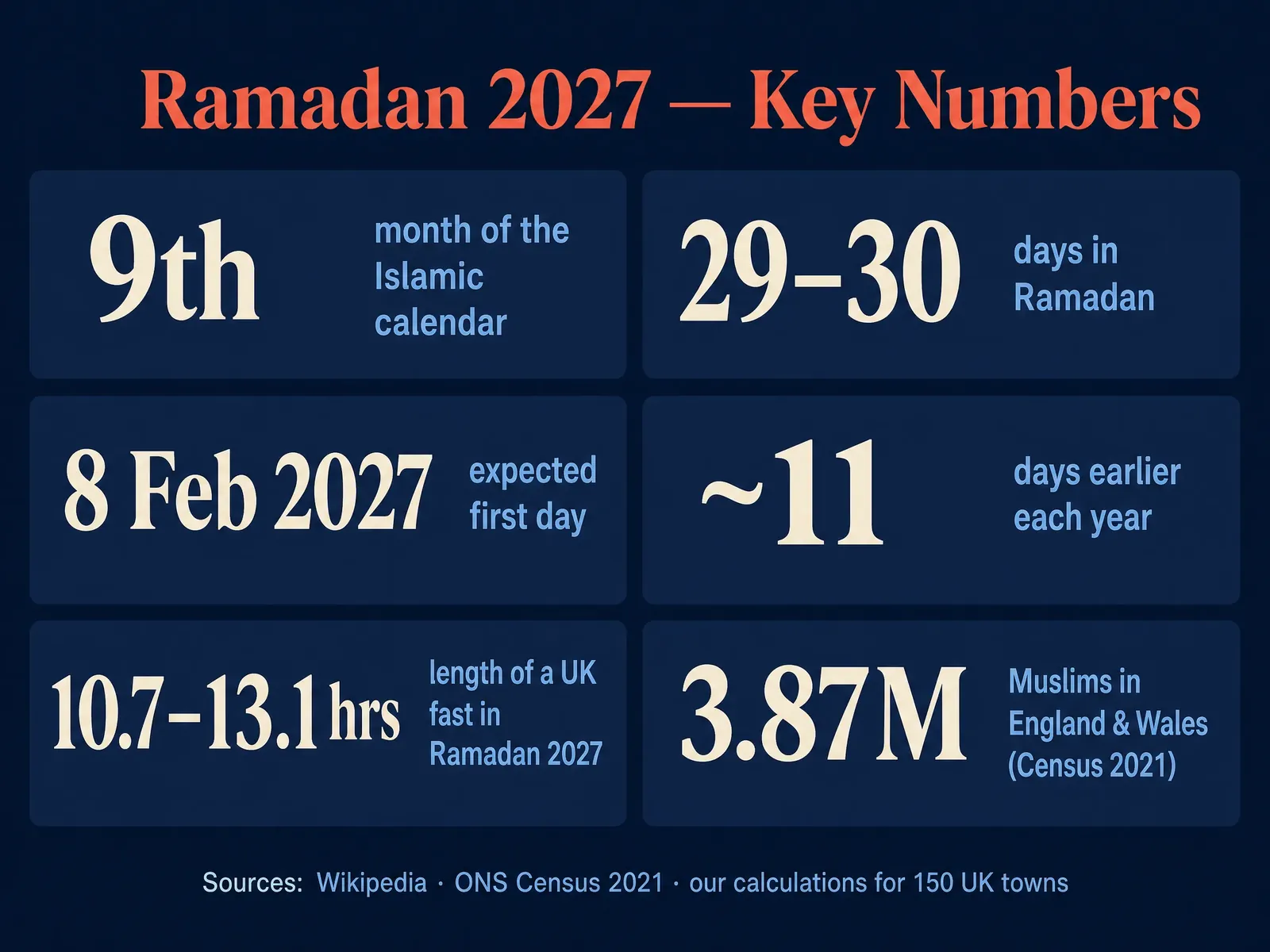
What is Ramadan? Ramadan is the ninth month of the Islamic calendar, when Muslims fast from dawn to sunset for 29 or 30 days. In 2027 it is expected to begin on 8 February, with UK fasts lasting about 11 to 13 hours.
Key Takeaways
- Ramadan is the ninth month of the lunar Islamic calendar and lasts 29 or 30 days, from one crescent moon to the next (Wikipedia).
- Fasting from dawn to sunset is one of the Five Pillars of Islam; the Quran commands it in Surah al-Baqarah 2:183–185 (Quran.com).
- Ramadan 2027 is expected to start on Monday 8 February 2027, with Eid al-Fitr on 9 or 10 March, subject to moon sighting.
- Across 150 UK towns we calculated, a Ramadan 2027 fast runs from 10.7 hours (Aberdeen, day 1) to 13.1 hours (southern England, day 30).
- Ramadan moves about 11 days earlier each year because the Islamic calendar follows the moon.
- About 3.87 million Muslims live in England and Wales, 6.5% of the population (Census 2021).
What is Ramadan and why do Muslims fast?
Ramadan is the month in which Muslims believe the Quran was first revealed, and fasting in it is a religious duty. The Quran says: "O believers! Fasting is prescribed for you—as it was for those before you—so perhaps you will become mindful ˹of Allah˺" (Quran 2:183, translation: The Clear Quran via Quran.com).
A later verse ties the fast to the month itself: "Ramaḍân is the month in which the Quran was revealed as a guide for humanity... So whoever is present this month, let them fast" (Quran 2:185).
Muslims describe the aim as taqwa, God-consciousness. The month is also a time for extra prayer, reading the Quran, charity and family meals.
What does fasting in Ramadan involve?
Fasting means no food, drink, smoking or sexual relations from dawn until sunset each day. Muslims eat a pre-dawn meal called suhoor (or sehri) and break the fast at sunset with iftar (Wikipedia).
The fast starts at the time of the Fajr prayer and ends at Maghrib, just after sunset. That is why every Ramadan timetable lists two key times: when sehri ends and when iftar begins. See today's times for London, Birmingham or Manchester.
The fast is usually broken with dates or water, following the Prophet's practice of fresh dates, then dry dates, then water (Abu Dawud 2356). Many people then recite the iftar dua.
Who has to fast during Ramadan?
Fasting is required of adult Muslims who are healthy and not travelling. Wikipedia's summary of the rules lists exemptions for people who are "acutely or chronically ill, traveling, elderly, breastfeeding, pregnant, or menstruating", and children do not have to fast (Wikipedia).
People who miss days for a temporary reason usually make them up later. Those who cannot fast at all, such as the chronically ill, may instead give fidya, food for a person in need for each day missed. Our fidya, fitrana and kaffarah guide explains the difference. Always ask a qualified scholar about your own situation.
When is Ramadan 2027?
Ramadan 2027 is expected to begin on Monday 8 February 2027 and end on 8 or 9 March, with Eid al-Fitr on 9 or 10 March. The exact start depends on the sighting of the new crescent moon, so mosques confirm it the evening before.
Because the Islamic calendar is lunar, Ramadan "migrates throughout the seasons", arriving about 11 days earlier each year (Wikipedia). In 2028 it is expected to start in late January. Follow the live Ramadan countdown or our Ramadan 2027 dates page.
How long is a Ramadan fast in the UK in 2027?
A Ramadan 2027 fast in the UK lasts between about 10.7 and 13.1 hours. Fasts start shorter and grow by roughly two hours over the month, because the days lengthen quickly in February and March.
We calculated sehri and iftar times for 150 UK towns using the Moonsighting Committee method, assuming Ramadan starts on 8 February. Here is how a selection of cities compare:
| City | Day 1 sehri ends | Day 1 iftar | Day 1 fast | Day 30 fast |
|---|---|---|---|---|
| London | 05:51 | 17:05 | 11.2 hrs | 13.1 hrs |
| Birmingham | 05:59 | 17:10 | 11.2 hrs | 13.0 hrs |
| Manchester | 06:04 | 17:08 | 11.1 hrs | 13.0 hrs |
| Bradford | 06:03 | 17:05 | 11.0 hrs | 13.0 hrs |
| Cardiff | 06:03 | 17:18 | 11.3 hrs | 13.1 hrs |
| Glasgow | 06:19 | 17:08 | 10.8 hrs | 13.0 hrs |
| Aberdeen | 06:14 | 16:55 | 10.7 hrs | 12.9 hrs |
The average fast across all 150 towns is about 12.1 hours. Mosque timetables can differ by 20 minutes or more at Fajr because they use different calculation methods; how prayer times are calculated explains why.
What happens during a day in Ramadan?
A typical Ramadan day follows the prayer times from before dawn until late at night.
- Suhoor — a meal before dawn, finished before sehri time ends.
- Fajr prayer — the dawn prayer, when the fast begins.
- The working day — work, school and daily life continue, without food or drink.
- Iftar — the fast is broken at sunset, often with dates and water. The Prophet said people "will remain on the right path as long as they hasten the breaking of the fast" (Bukhari 1957).
- Isha and taraweeh — the night prayer, followed by extra congregational prayers. See the taraweeh dua.
What are the most important nights and days of Ramadan?
The last ten nights of Ramadan are the most important, because they include Laylat al-Qadr, the Night of Power. Muslims believe the Quran was first revealed on this night, which falls on an odd-numbered night in the last ten (Wikipedia).
The Prophet described it as "a night which is better than a thousand months" (Sunan an-Nasa'i 2106). In 2027 the last ten nights are expected to begin on the evening of 27 February; see Laylat al-Qadr 2027.
The month ends with Eid al-Fitr, the festival of breaking the fast. Before the Eid prayer, every Muslim who can afford it gives zakat al-fitr, a small charity paid "before the people went out to offer the 'Id prayer" (Bukhari 1503).
What should non-Muslims know about Ramadan?
For friends and colleagues, the most helpful things are simple: a greeting, flexibility and understanding about tiredness. "How can I support my Muslim colleague during Ramadan?" is a popular question on Reddit's r/islam (Reddit).
- Say Ramadan Mubarak ("blessed Ramadan").
- Avoid scheduling working lunches or late meetings near iftar time.
- Don't feel you must stop eating in front of people who are fasting; most won't mind.
- Expect lower energy in the afternoon, especially in the first week.
What is Ramadan: frequently asked questions
What is Ramadan in simple words?
Ramadan is the Islamic month when Muslims fast from dawn to sunset for 29 or 30 days, pray more, read the Quran and give to charity.
When does Ramadan start in 2027?
It is expected to start on Monday 8 February 2027, subject to moon sighting.
How long is Ramadan?
29 or 30 days, depending on when the next crescent moon is seen.
Can you drink water during Ramadan?
No, not during fasting hours. Water is allowed from iftar at sunset until sehri ends before dawn.
How long do Muslims fast in the UK in Ramadan 2027?
About 10.7 to 13.1 hours a day, depending on the town and the day of the month.
Why does Ramadan change every year?
The Islamic calendar is lunar, so each year is about 11 days shorter than the solar year.
What is the end of Ramadan called?
Eid al-Fitr, the festival of breaking the fast, on the first day of the month of Shawwal.
What do you say to someone during Ramadan?
"Ramadan Mubarak" (blessed Ramadan) or "Ramadan Kareem" (generous Ramadan).