
What Is Sadaqah?
A complete guide to voluntary charity in Islam
GIVE SADAQAH
Sadaqah Guide · Last updated: September 2026
By HNCO — Hajjah Naziha Charitable Organisation · UK non-profit organisation delivering Sadaqah Jariyah water and masjid projects in Pakistan and Kenya since 2010
What is sadaqah? Sadaqah is any voluntary act of charity or kindness in Islam — money, a smile, or removing harm from a path all count — with no fixed amount and no restriction on who receives it, unlike Zakat.
Key Takeaways
- Sadaqah is voluntary charity with no minimum amount, no fixed schedule, and no restriction on who can receive it — unlike Zakat, which is obligatory and rule-bound.
- The word comes from the Arabic root sidq ("truthfulness") — sadaqah is a sign of sincere faith, and the Quran and early Islamic practice used the words sadaqah and Zakat almost interchangeably.
- "Charity does not decrease wealth" — a hadith narrated by Abu Hurairah, graded sahih (Sahih Muslim 2588).
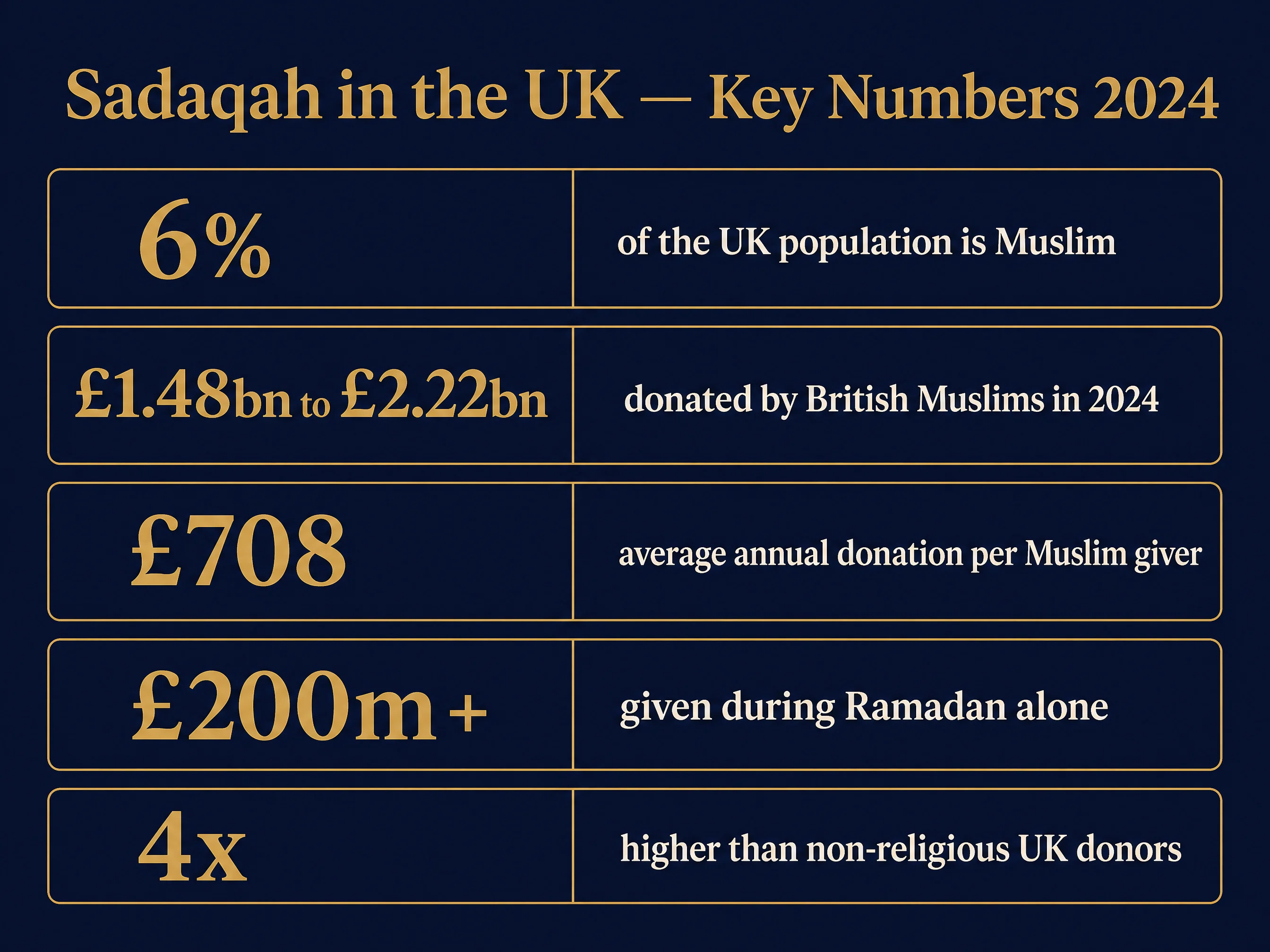
- British Muslims donated an estimated £1.48bn–£2.22bn in 2024 despite being just 6% of the UK population, averaging £708 per giver — more than four times the average non-religious UK donor (Muslim Charities Forum, 2025).
- Sadaqah Jariyah — "ongoing charity" — is a specific category of sadaqah whose reward continues after death, per the hadith naming it one of three deeds that outlive a person (Sahih Muslim 1631).
What is sadaqah?
Sadaqah is any voluntary act of charity or kindness given for the sake of Allah, with no fixed amount, no set schedule, and no restriction on who can receive it. It can be money, but it doesn't have to be — a kind word, a smile, or helping someone counts too. The defining feature isn't the form the giving takes; it's that it's freely chosen rather than owed.
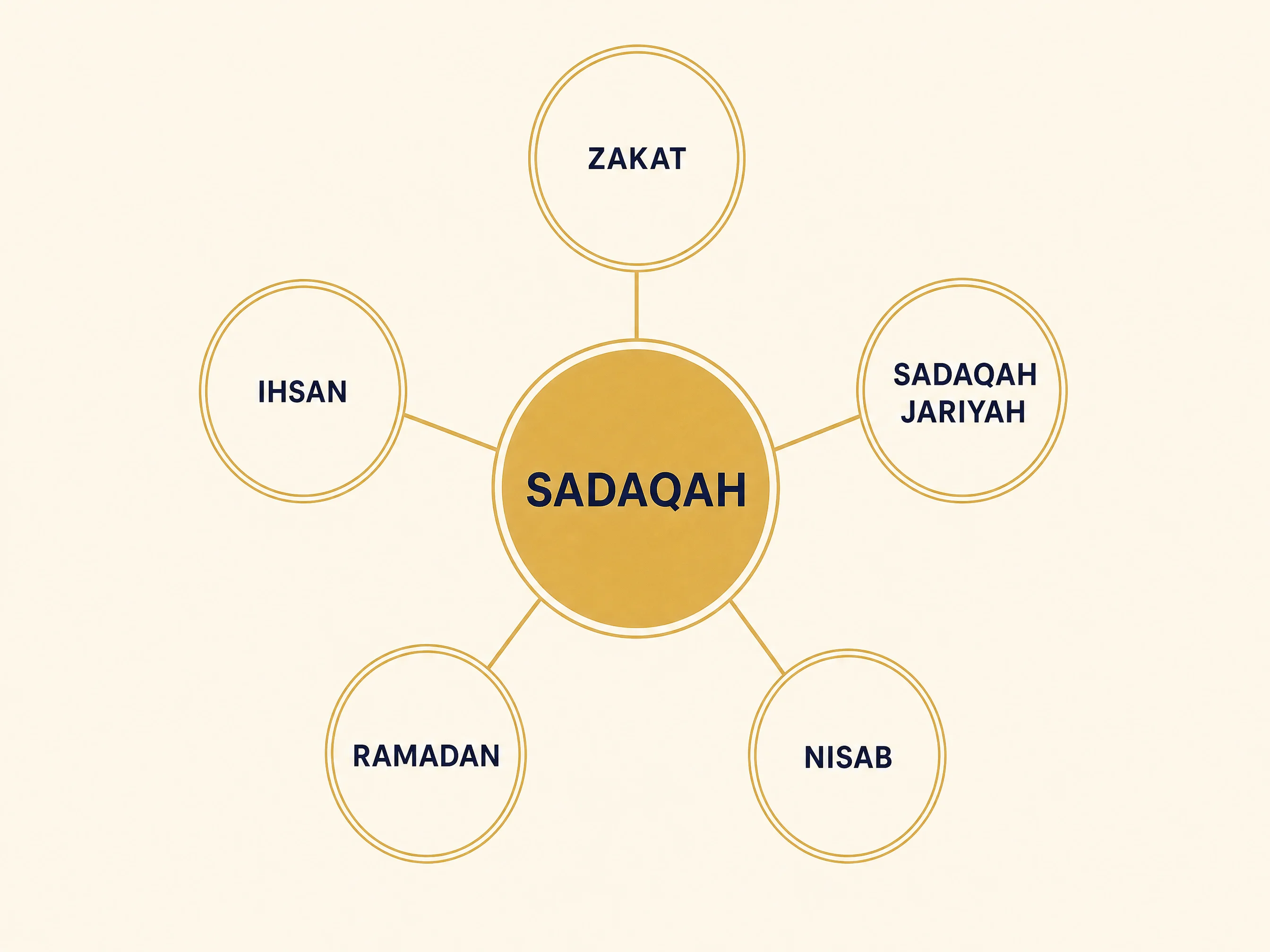
This is what separates sadaqah from Zakat, the obligatory annual due calculated at 2.5% of qualifying wealth above the nisab threshold and restricted to eight specific categories of recipients named in the Quran. Sadaqah has none of those rules — which is also why it's harder to pin down with a single number or a single form.
Where does the word "sadaqah" come from?
"Sadaqah" comes from the Arabic root sidq, meaning "truthfulness" — the same root behind words for sincerity and honesty. The connection is deliberate: giving sadaqah is traditionally understood as outward proof of sincere faith, not just a transaction.
There's a genuinely interesting historical wrinkle here worth being precise about. During the Quran's revelation, the words "sadaqah" and "Zakat" were used almost interchangeably — which is why the Quran itself uses the word "sadaqah" in a verse widely understood by scholars to be describing what later became formalised as Zakat: "Take from their wealth a charity [sadaqatan] to purify and bless them" (Quran 9:103). The two terms only became clearly distinguished in later Islamic jurisprudence, which is why some older texts use "sadaqah" where a modern reader would expect "Zakat."
What does sadaqah look like in practice?
Sadaqah is broader than money. The Prophet ﷺ described a hierarchy for those with nothing to give financially: give from your wealth, or if you can't, work and give from your earnings, or if you can't, help someone in need directly, or if you can't, encourage others toward good, or — at the very minimum — simply refrain from causing harm.
Specific, commonly cited examples include:
- Giving money — to a person in need, a mosque, or a charity project.
- Smiling at another person — "Your smiling in the face of your brother is charity" (Jami' at-Tirmidhi 1956, graded hasan).
- Removing something harmful from a path — a widely cited example of sadaqah requiring no money at all.
- Teaching or sharing useful knowledge.
- A good word or a fair judgment between two people.
How is sadaqah different from Zakat and Sadaqah Jariyah?
All three terms describe giving, but they aren't interchangeable. The table below lays out the practical differences:
| Factor | Sadaqah | Zakat | Sadaqah Jariyah |
|---|---|---|---|
| Obligation | Voluntary | Obligatory (a Pillar of Islam) | Voluntary |
| Amount | No fixed amount | 2.5% of qualifying wealth | No fixed amount |
| Who can receive it | Anyone in need, or general good causes | Restricted to eight categories in the Quran | Anyone benefiting from the ongoing project |
| Timing | Any time | Once per lunar year, on wealth held a full year | Given once; benefit continues afterward |
| Duration of reward | Tied to the single act | Tied to the single payment | Continues for as long as the benefit lasts, even after death |
See HNCO's dedicated guide on the difference in practice when choosing where to give, and the sadaqah calculator for working out a starting amount — since, unlike Zakat, there's no formula to follow.
What is sadaqah jariyah, and how does it differ from regular sadaqah?
Sadaqah jariyah means "ongoing" or "recurring" charity — a specific category of sadaqah whose benefit, and reward, continues after the act itself, and even after the giver's death. The Prophet ﷺ said that when a person dies, their deeds end except three: "a continuing charity, beneficial knowledge, or a righteous child who prays for him" (Sahih Muslim 1631). A water well, a masjid, or a Quran left behind for others to read are the classic examples — each keeps producing benefit long after the original gift.
HNCO's own sadaqah jariyah projects — water wells and masjid contributions in Pakistan and Kenya — are built specifically around this category, precisely because the ongoing-benefit structure is what makes sadaqah jariyah distinct from a one-off gift.
Why does sadaqah matter to UK Muslims today?
Sadaqah is a significant part of UK Muslim life in practice, not just in theory. British Muslims donated an estimated £1.48 billion to £2.22 billion in 2024 despite making up only around 6% of the UK population, with more than £200 million of that given during Ramadan alone (Muslim Charities Forum, 2025). The average Muslim donor gave around £708 across the year — more than four times the average non-religious UK donor — at a time when overall UK charitable giving has been declining.
What are the most common misconceptions about sadaqah?
A few myths come up repeatedly, and it's worth correcting them directly:
- "Sadaqah has to be money." It doesn't — a smile, a kind word, or removing harm from someone's path all count, per the hadith evidence above.
- "Sadaqah reduces how much you have." The Prophet ﷺ explicitly said charity does not decrease wealth (Sahih Muslim 2588) — a statement about spiritual and, many argue, practical abundance, not a literal accounting claim.
- "Sadaqah and Zakat are the same thing." They overlap in origin (see the etymology section above) but function very differently today — Zakat is obligatory and rule-bound; sadaqah is voluntary and open-ended.
- "Sadaqah only counts during Ramadan." Ramadan sees a large concentration of giving in practice, but sadaqah carries no seasonal restriction — see HNCO's guide to giving sadaqah in Rajab for one example of giving outside Ramadan.
How much should you give, and how do you start?
There's no fixed figure — that's the point of sadaqah being voluntary. A reasonable approach is to give an amount you can sustain consistently rather than a one-off amount that strains you; HNCO's sadaqah calculator can help you find a starting figure, and the guide to setting up monthly sadaqah covers how to automate it. If you're giving as a gift for a birthday, wedding, or someone's recovery, see HNCO's guides to sadaqah as a gift for someone living and sadaqah jariyah gifts for weddings and birthdays. And if you're donating to an organisation you haven't given to before, HNCO's guide on how to verify an Islamic charity in the UK is worth reading first.
Compare before you give
Understand the difference between Zakat and Sadaqah, use the detailed Sadaqah Jariyah options comparison to compare price, lifespan and people served, then read how much of a donation reaches charitable work.
Give Sadaqah with HNCO
Turn your sadaqah into a water pump, a masjid contribution, or a forever donation — ongoing benefit from a single gift.
Give Sadaqah NowSadaqah — Frequently Asked Questions
What is sadaqah in Islam?
Sadaqah is any voluntary act of charity or kindness given for the sake of Allah — money, a smile, or removing harm from a path all count — with no fixed amount and no restriction on who can receive it.
What is the difference between sadaqah and Zakat?
Zakat is obligatory, calculated at a fixed 2.5% of qualifying wealth above the nisab threshold, and restricted to eight categories of recipients named in the Quran. Sadaqah is voluntary, with no fixed amount, schedule, or restriction on recipients.
Does sadaqah have to be money?
No. A smile, a kind word, teaching someone something useful, or removing something harmful from a path all count as sadaqah, according to hadith evidence.
What is sadaqah jariyah?
Sadaqah jariyah is “ongoing charity” — a category of sadaqah, such as a water well or a mosque, whose benefit and reward continue after the initial act, even after the giver's death.
Is there a minimum amount for sadaqah?
No. Sadaqah has no fixed minimum, unlike Zakat's nisab threshold — any amount, however small, counts.
Does giving sadaqah reduce your wealth?
According to a hadith graded sahih in Sahih Muslim, charity does not decrease wealth — a statement understood as both a spiritual and, many argue, practical principle.
How much do British Muslims give in sadaqah each year?
An estimated £1.48 billion to £2.22 billion in 2024, according to the Muslim Charities Forum, despite British Muslims making up only around 6% of the UK population.