
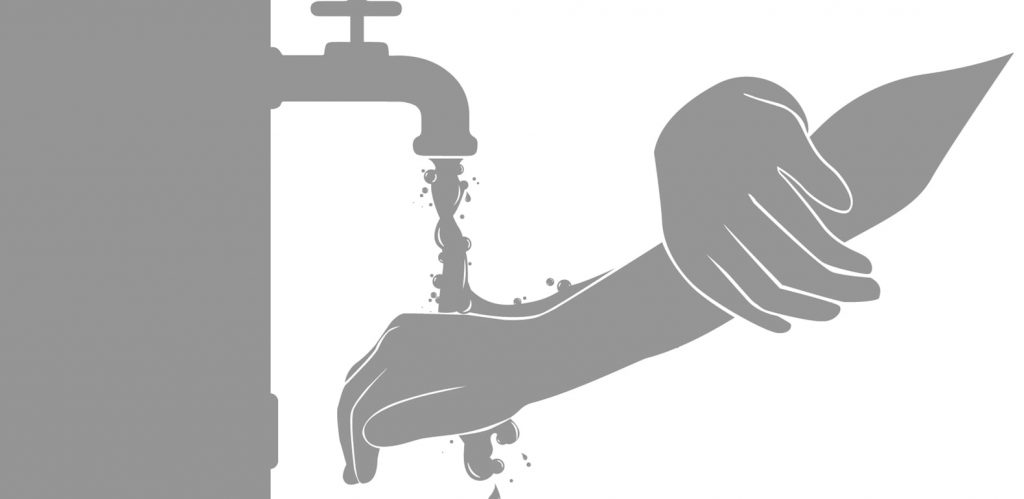
Wudu (وضوء) is the Islamic ritual ablution — the prescribed washing of the face, arms, head and feet — required before Salah (prayer) and other specific acts of worship. Commanded in the Quran (5:6) and demonstrated by the Prophet Muhammad ﷺ, it removes minor ritual impurity and, according to authentic hadith, spiritually cleanses the believer from minor sins with every drop.
Key Takeaways
- Wudu is ordained in Quran 5:6 — one of only a handful of physical acts described explicitly in the Quran
- Four obligatory (fard) acts must all be completed: washing face, washing arms to elbows, wiping head, washing feet to ankles
- Mentioned alongside Salah (prayer) in over 82 verses of the Quran, reflecting its centrality to Islamic practice
- The Arabic root w-ḍ-ʾ (و-ض-ء) means cleanliness and beauty — wudu is simultaneously physical and spiritual preparation
- All four Sunni schools (Hanafi, Maliki, Shafi'i, Hanbali) agree on the four core fard acts — differences exist only in detail
- Wudu is valid for women and men alike; specific women's rulings cover hair, nail polish, and post-menstruation ghusl
- If water is unavailable, tayammum (dry ablution) is the permitted substitute — Quran 5:6
What does wudu mean?
The word wudu (وضوء) derives from the Arabic root w-ḍ-ʾ, which carries the meaning of cleanliness, brightness, and beauty. Linguistically, this root signals that wudu is not merely hygienic washing — it is a brightening, a beautification of the self before standing in front of Allah.
In Islamic jurisprudence (fiqh), wudu is defined as the act of ritual purification that removes hadath asghar (minor ritual impurity). It is a precondition for Salah, touching the Quran, and performing tawaf (circumambulation of the Kaaba). Without wudu, these acts are not valid.
The term is sometimes transliterated as wuzu, wuzoo, or wudhoo in South Asian usage — all refer to the same act.
What is the Quranic command for wudu?
The primary Quranic evidence is Surah Al-Ma'ida, verse 6:
"O you who believe! When you rise for prayer, wash your faces and your hands to the elbows, and wipe your heads, and wash your feet to the ankles. And if you are in a state of major impurity, then purify yourselves. And if you are ill or on a journey, or if any of you has come from the lavatory, or you have touched women, and you cannot find water, then use clean earth and wipe your faces and hands with it." — Quran 5:6 (Al-Ma'ida)
Classical scholars of tafsir — including Ibn Kathir and Al-Qurtubi — identify this verse as establishing the four physical fard (obligatory) acts of wudu. The verse also introduces tayammum (dry ablution) as the valid substitute when water is genuinely unavailable.
What are the 4 fard (obligatory) acts of wudu?
The four acts below are agreed upon by all four Sunni schools. Omitting any one — deliberately or by accident — invalidates the wudu entirely.
| Act | What it covers | Once or three times? |
|---|---|---|
| 1. Wash the face | From hairline to chin; from earlobe to earlobe | Fard: once. Sunnah: three times |
| 2. Wash both arms | From fingertips to and including the elbows | Fard: once. Sunnah: three times |
| 3. Wipe the head (masah) | Minimum portion varies by school (see below) | Sunnah: once, full head |
| 4. Wash both feet | From toes to and including the ankles | Fard: once. Sunnah: three times |
The Sunnah additions — rinsing the mouth (madmadah), washing inside the nose (istinshaq), making intention (niyyah) explicitly, and washing each part three times — multiply reward without being obligatory for validity.
How do the four schools of thought differ on wudu?
The four Sunni schools (madhabs) agree on the core fard acts. Their differences lie in details that are worth knowing:
| School | Niyyah required? | Sequence (tartib)? | Head wiping minimum |
|---|---|---|---|
| Hanafi | Strongly recommended (sunnah), not fard | Not obligatory | One quarter of head |
| Maliki | Fard | Continuity (muwalat) required | Entire head |
| Shafi'i | Fard | Sequence (tartib) obligatory | Any portion |
| Hanbali | Fard | Sequence obligatory | Entire head |
For most UK Muslims following the Hanafi school, niyyah is an internal intention — it does not need to be spoken aloud — and the sequence of acts, while recommended, does not invalidate wudu if accidentally reversed.
What are the spiritual benefits of wudu?
The Prophet Muhammad ﷺ described the spiritual dimension of wudu in numerous authentic narrations. The most cited is from Sahih al-Bukhari:
"When a believing servant performs wudu and washes his face, every wrong deed he committed with his eyes is washed away with the last drop of water. When he washes his hands, every wrong deed committed by his hands falls away... until he emerges cleansed of sins." — Sahih Muslim (via al-Bukhari's collection of ablution narrations)
Beyond hadith, scholarly tradition identifies several overlapping dimensions to wudu's benefit:
- Removal of minor sins — each body part washed carries away corresponding transgressions
- Spiritual readiness — standing in prayer in a state of purity mirrors internal attentiveness to Allah
- The light of wudu on the Day of Judgement — hadith describe believers being distinguished by the brightness (ghurra) on the parts of the body washed in wudu
- Protection from anger — the Prophet ﷺ advised making wudu when feeling anger, as water cools the heat of emotion
What breaks wudu?
The following nullifiers (nawaqid al-wudu) are agreed upon across all four Sunni schools:
- Passing wind, urine, stool, or madhi (pre-seminal fluid)
- Deep sleep — where consciousness is lost and the person no longer controls themselves
- Losing consciousness (fainting, intoxication)
- Excessive bleeding from wounds (scholarly differences exist on what counts as excessive)
- Vomiting a mouthful or more
Normal activities that do not break wudu include: eating, drinking, speaking, laughing, bleeding from a small cut (per Hanafi and Maliki positions — Shafi'i and Hanbali differ), and touching a member of the opposite sex without desire (Hanafi and Maliki consensus).
What is the difference between wudu, ghusl and tayammum?
These are the three forms of Islamic ritual purification, each addressing a different level of impurity:
| Type | What it addresses | When required |
|---|---|---|
| Wudu | Minor ritual impurity (hadath asghar) | Before each prayer, touching Quran, tawaf |
| Ghusl | Major ritual impurity (hadath akbar) | After intimacy, menstruation, postnatal bleeding, emission |
| Tayammum | Substitute for wudu or ghusl | When water is genuinely unavailable or harmful to use |
After ghusl, a person must still perform wudu before prayer — ghusl removes major impurity but does not substitute for wudu. Some scholars hold that ghusl performed with full intention can suffice for both, provided all wudu areas are washed.
Does wudu need to be renewed before every prayer?
No — wudu remains valid until one of its nullifiers occurs. A person who makes wudu at Fajr and does not break it retains a valid wudu throughout the day. Many scholars encourage maintaining wudu continuously as an act of worship in itself.
The obligation to renew wudu triggers only when a nullifier has occurred. Where doubt exists — "did I pass wind, or did I imagine it?" — the Prophet ﷺ taught that one should not abandon prayer due to doubt unless one is certain (Bukhari and Muslim). Certainty of wudu is not broken by mere suspicion.
Frequently asked questions about wudu
What is wudu in Islam?
What is the Quranic verse for wudu?
What are the 4 fard acts of wudu?
What breaks wudu?
Does wudu have to be said in Arabic?
How long does wudu last?
Is wudu the same for men and women?
Can you pray without wudu in an emergency?
Related reading: Wudu step by step · Correct order of wudu · Wudu for women · Wudu in Islam · Sadaqah Jariyah · Donate a water pump
Methodology: this article draws exclusively on primary Islamic sources — Quran, authenticated hadith collections (Bukhari, Muslim, Abu Dawud), and classical scholarly tafsir. No anonymous community sources were used in line with YMYL best practice for religious guidance content. Last reviewed June 2026.