
To build a masjid in Pakistan with an Islamic charity means funding a complete place of worship — prayer hall, ablution area, and madrassa — serving 70 or more worshippers for generations, and earning ongoing spiritual reward for every prayer, Quran lesson, and act of worship performed inside it.
Key Takeaways
- The Prophet ﷺ said: "Whoever builds a mosque for Allah, Allah will build for him the like of it in Paradise" — Sahih Bukhari 450, Sahih Muslim 533.
- HNCO builds a complete concrete masjid in Pakistan for £8,500 — including 2 washrooms, ablution area, and a madrassa.
- Each masjid serves 70+ worshippers and enables five daily prayers, Friday prayer, Eid prayers, and children's Quran education.
- Despite 600,000+ mosques nationally, millions in rural Pakistan still have no masjid within their village.
- A concrete masjid, properly maintained, can serve a community for 50 years or more.
- Even a partial contribution earns reward: "Whoever builds a mosque the size of a sparrow's nest for Allah" earns a house in Jannah (Ibn Majah).
- The masjid also functions as a madrassa, community hall, and refuge — multiplying its sadaqah jariyah impact.
What does it mean to build a masjid in Pakistan as sadaqah jariyah?
Sadaqah jariyah (صدقة جارية) — "flowing charity" — refers to any charitable act whose benefit continues after the donor's death, with rewards credited to them for as long as that benefit reaches people. Building a masjid is considered one of the highest and most enduring forms of sadaqah jariyah in Islamic scholarship, for a precise reason: a functioning mosque never stops generating acts of worship.
Every time someone enters HNCO's masjid in Pakistan to pray Fajr, or a child sits down for Quran class, or a congregation gathers for Friday prayer, that act of worship is traceable back to the donor who funded the building. Unlike a food parcel — which benefits once — or even a water pump, which serves a physical need, a masjid serves the spiritual, educational, and social life of a community simultaneously. The reward therefore compounds across multiple dimensions for as long as the building stands.
For UK-based Muslims wanting to give the most durable form of sadaqah jariyah, building a masjid in Pakistan represents giving at a scale that is otherwise impossible within the UK — a complete mosque that would cost hundreds of thousands of pounds to build here can be funded for £8,500 in a rural Pakistani community that needs it most.
What does the hadith say about the reward for building a masjid?
The primary hadith on this subject is one of the most widely cited in Islamic tradition. Uthman ibn Affan (may Allah be pleased with him) reported that the Prophet ﷺ said:
This hadith is classed as sahih (rigorously authenticated) and is recorded across the six canonical hadith collections, giving it the strongest possible evidentiary standing in Islamic jurisprudence. The scholars of hadith note that the phrase "the like of it in Paradise" indicates a reward proportional to — and greater than — the effort expended.
A second hadith, narrated by Abu Dharr al-Ghifari, adds an important dimension for donors who can only contribute partially. The Prophet ﷺ said: "Whoever builds a mosque for Allah's sake, even if it be as small as a sparrow's nest, Allah will build for him a house in Paradise." (Ibn Majah). This narration explicitly removes any minimum threshold — partial contributions are fully rewarded, making group or instalment giving entirely valid.
A third narration, reported by Abu Hurairah and recorded in multiple sound chains, lists building a masjid alongside beneficial knowledge and a righteous child as deeds that continue to reach a believer after death — the same three categories as sadaqah jariyah in the famous Sahih Muslim hadith. Building a masjid is therefore doubly confirmed as ongoing charity by two separate prophetic traditions.
Why do rural communities in Pakistan still need masjids?
Pakistan has over 600,000 registered mosques — among the highest concentrations in the world. Yet the distribution is profoundly uneven. The vast majority of mosques are concentrated in urban centres and prosperous rural towns. In impoverished, remote villages — particularly in provinces like Punjab's DG Khan district, Sindh, and parts of KPK — entire communities have never had a masjid within their locality.
The practical consequences are significant. Without a local masjid:
- Families must walk several miles to the nearest place of worship, making daily prayers in congregation practically impossible
- Friday (Jumu'ah) prayer — obligatory for Muslim men — cannot be observed as a proper congregation without a masjid
- Children learn the Quran outdoors, in open fields, or cramped private homes without proper space or facilities
- The community has no neutral gathering place for dispute resolution, social events, or collective decision-making
- Adults have no access to regular Islamic education or scholarly guidance
HNCO's masjid programme specifically targets communities identified as the most deserving — villages where families are too poor to fund construction themselves and where no external intervention has yet reached. The projects are located in DG Khan and other districts across Punjab, Sindh, and KPK. For a detailed look at what has already been built, the foundations of a community project page documents completed installations.
What is included in HNCO's build a masjid in Pakistan project?
HNCO's £8,500 masjid project delivers a complete, functional place of worship — not a shell structure. The specification was developed with field partners who have over a decade of mosque construction experience across Pakistan. Every element below is included in the single £8,500 cost.
| Component | Specification |
|---|---|
| Structure | 28×16 ft concrete construction, concrete roof — permanent and weatherproof |
| Capacity | 70+ worshippers simultaneously |
| Washrooms | 2 separate washrooms included |
| Ablution area | Full wuzu khana (ritual washing area) with water connection |
| Utilities | Electrification, sanitary fittings, whitewashing — all included |
| Education space | Madrassa for children's Quran education and adult classes |
| Location | DG Khan district, Punjab Province, Pakistan |
| Community handover | Full ownership transferred to community with maintenance responsibility |
| Total cost | £8,500 — complete build, no additional charges |
The concrete specification matters for longevity. Many informal prayer spaces in rural Pakistan use temporary materials that deteriorate within a decade. A concrete structure with a concrete roof, properly maintained by the community, can serve for 50 years or more — extending the sadaqah jariyah far beyond the donor's own lifetime and into the next generation.
Community ownership is built into the project design. HNCO and its field partners ensure the local community takes responsibility for the masjid on completion, which has been shown to significantly extend the life of projects compared to externally managed maintenance models. For more on HNCO's broader approach to building mosques as charity, the main mosque appeal page covers ongoing fundraising across multiple projects.
How much does it cost to build a masjid in Pakistan in 2026?
The cost to build a masjid in Pakistan varies by size, specification, and location. HNCO's current project delivers a complete 70+ capacity mosque with full facilities for £8,500. This is a fixed, all-inclusive price — no additional charges for washrooms, utilities, or the madrassa space.
For context, UK-based Islamic charities currently offering mosque construction in Pakistan typically quote the following ranges:
| Charity | Quoted cost | Capacity | Notes |
|---|---|---|---|
| HNCO | £8,500 | 70+ | Includes madrassa, 2 washrooms, wuzu khana, electrification |
| SKT Welfare | £6,500 | ~200 | Basic structure; specification varies |
| UKIM | £7,500 | Varies | Rural rebuild or new build |
| LIA Relief Trust | £10,000–£15,000 | Varies | Small to large mosque |
The variation in pricing reflects differences in build specification, included facilities, field partner overheads, and community selection criteria. HNCO's £8,500 figure covers a concrete-roof structure with full utilities and a madrassa — making it a well-specified build at a competitive price point. A detailed breakdown of what drives costs is available on the cost of building a mosque in Pakistan page.
For donors who cannot fund a complete masjid alone, the prophetic tradition is clear that partial contributions earn proportional reward. HNCO accepts donations toward mosque projects at any level, and groups of donors — families, friends, mosque communities — can pool contributions toward the full £8,500 build. This is consistent with HNCO's model for forever donations more broadly.
How does a single masjid transform a community long-term?
The impact of a masjid extends well beyond a place to perform salah. In communities that previously had none, a new masjid creates a cascade of long-term changes that Islamic history has consistently documented — from the time of the Prophet's first mosque in Medina to contemporary development research.
The immediate effect is restored religious practice: five daily prayers, Friday congregation, Eid prayers, and Tarawih in Ramadan — none of which can be properly observed without a dedicated space. For communities that had previously been praying in open fields or cramped homes, this represents a restoration of fundamental religious rights.
The longer-term effects compound across several dimensions:
- Children's Islamic education — the integrated madrassa provides Quran teaching, basic Islamic knowledge, and moral education for children who would otherwise have no access. This is a form of beneficial knowledge (ilm nafi') that itself qualifies as sadaqah jariyah.
- Community cohesion — the masjid serves as a neutral space for dispute resolution, community meetings, and collective decision-making, functions historically documented across the Muslim world.
- Social safety net — after-prayer gatherings create visibility for vulnerable community members, enabling informal support networks for the elderly, widowed, and poor.
- Economic signalling — a permanent masjid signals community permanence and stability, which has historically been shown to encourage trade and investment in an area.
HNCO's sister project, building a mosque in Bangladesh, documents similar long-term community outcomes across a different national context — validating the model beyond Pakistan.
Who can donate to build a masjid in Pakistan — and is zakat permitted?
Any Muslim who has surplus wealth and wants to give sadaqah jariyah can donate toward building a masjid in Pakistan. There is no minimum or maximum — as the hadith of Abu Dharr confirms, even a small contribution earns reward. HNCO accepts donations from individuals, families, mosque communities, and corporate donors in the UK and globally.
The question of zakat is more nuanced and is a matter of scholarly disagreement. The mainstream position among Hanafi, Maliki, and Shafi'i scholars is that zakat cannot be directed toward building a mosque, because all eight categories of zakat recipients in Surah At-Tawbah (9:60) are personal recipients — individuals, not institutions. Mosque construction is not listed among them.
However, some scholars in the Hanbali tradition hold that if the project directly serves the poor and destitute — which HNCO's programme demonstrably does — there is a case for permissibility. If you wish to donate zakat toward a mosque project, HNCO recommends consulting a qualified Islamic scholar for a ruling aligned with your madhab. For broader zakat guidance, the HNCO zakat guide covers nisab calculation and eligible recipients in detail.
The default recommendation is to give voluntary sadaqah or sadaqah jariyah funds toward the mosque project — this is unambiguously valid under all scholarly positions and carries the full reward of the hadith. For donors who also give sadaqah on a regular basis, the mosque project is a natural complement to ongoing voluntary giving.
How do you verify a masjid project before donating in the UK?
The five markers of a trustworthy mosque project are consistent with those for any major Islamic giving:
- UK registration — the organisation should be a UK-registered non-profit with verifiable legal oversight and annual reporting
- Photographic documentation — progress and completion photographs showing the actual build, not stock imagery
- Community selection transparency — clear criteria for how the target community was identified as most deserving
- Community ownership model — confirmation that the local community takes responsibility for maintenance post-completion
- Financial breakdown — itemised costs showing how the donation is spent between construction, labour, fittings, and overhead
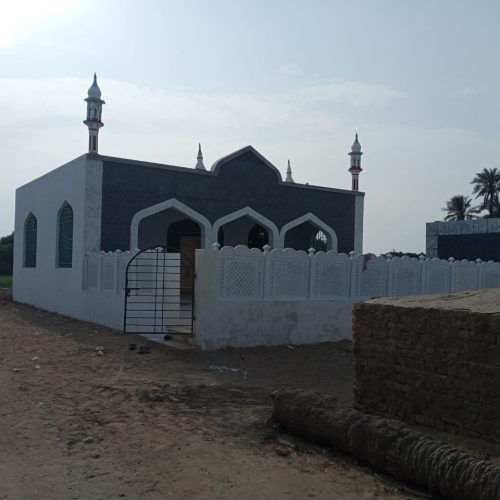
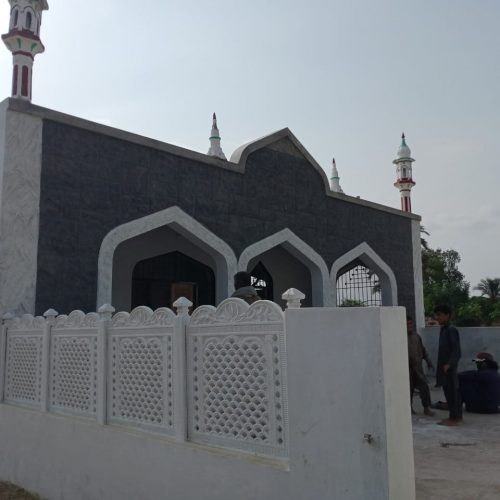
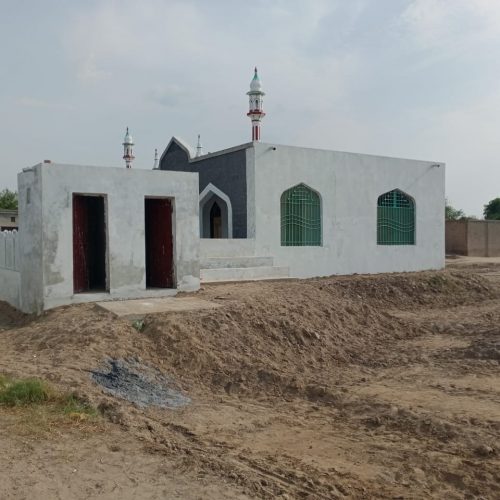
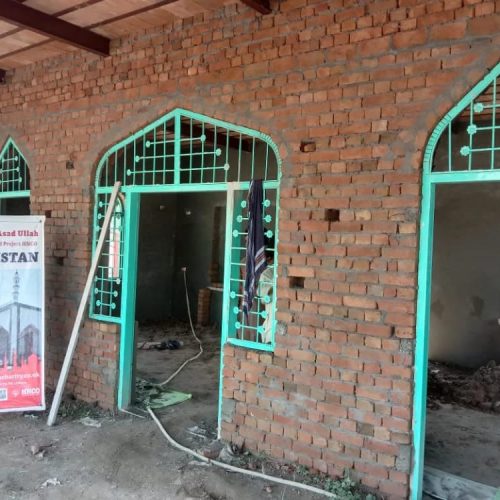
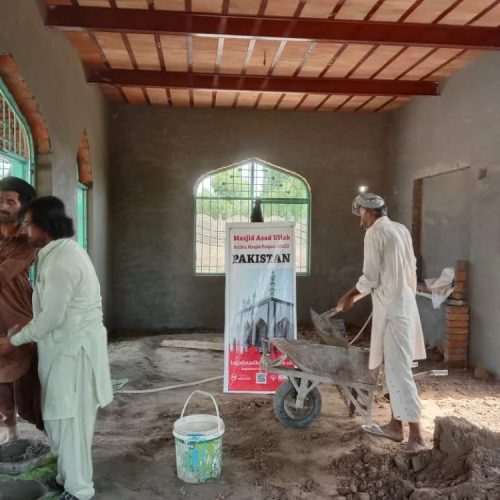
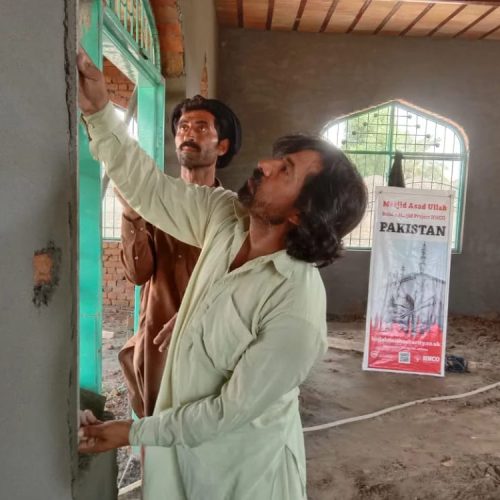
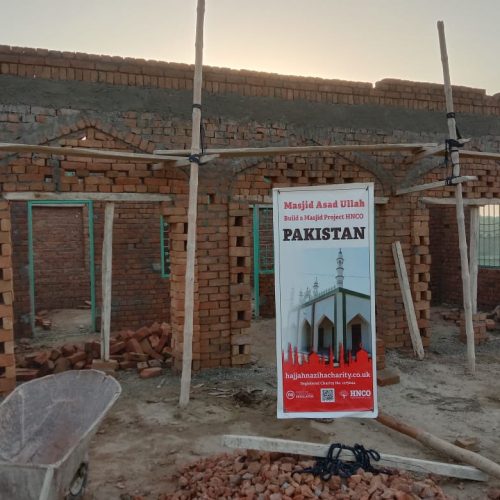
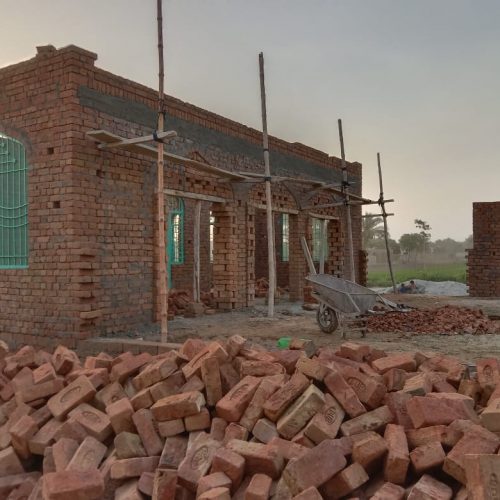
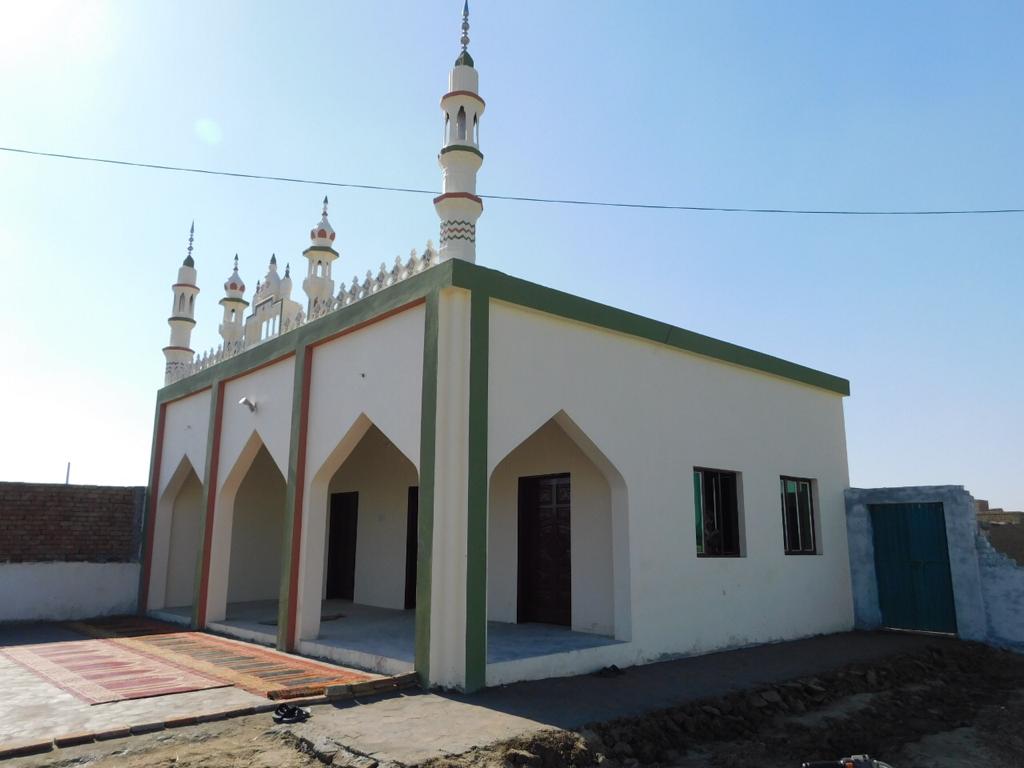
HNCO is a UK-registered non-profit organisation based in Nelson, Lancashire. Its completed masjid projects are documented with photographs of construction stages and the finished building — the images from the 2020 first build in Pakistan are published below. The how your donations are spent page provides a broader accountability breakdown across all HNCO programmes.
For donors who also want to give water infrastructure alongside a masjid project — addressing both spiritual and physical needs in the same community — HNCO's water pump donation programme operates in overlapping regions of Pakistan and can be funded simultaneously.
HNCO masjid builds in Pakistan — completed projects
Frequently asked questions about building a masjid in Pakistan
How much does it cost to build a masjid in Pakistan with HNCO?
HNCO's complete masjid project costs £8,500. This covers a 28×16 ft concrete structure with a concrete roof, 70+ worshipper capacity, 2 washrooms, a full ablution area (wuzu khana), sanitary fittings, water connection, electrification, whitewashing, and a madrassa space. No additional costs apply.
Is building a masjid in Pakistan considered sadaqah jariyah?
Yes — building a masjid is one of the most explicitly endorsed forms of sadaqah jariyah in the hadith literature. The Prophet ﷺ said: "Whoever builds a mosque for Allah, Allah will build for him the like of it in Paradise" (Sahih Bukhari 450, Sahih Muslim 533). Every prayer performed in the masjid earns ongoing reward for the donor, including after death.
Can zakat be used to build a masjid in Pakistan?
This is a matter of scholarly difference. The majority Hanafi, Maliki, and Shafi'i position does not permit zakat for mosque construction, as the eight Quranic categories (At-Tawbah 9:60) are personal recipients rather than institutions. Some Hanbali scholars permit it where the project serves the poor directly. HNCO recommends giving voluntary sadaqah rather than zakat toward the mosque project, and consulting a qualified Islamic scholar if you wish to use zakat.
What is included in HNCO's masjid build in Pakistan?
The £8,500 project includes: a concrete 28×16 ft structure, concrete roof, 70+ worshipper capacity, 2 washrooms, wuzu khana, sanitary fittings, water connection, electrification, whitewashing, and a madrassa space for children and adults. The community takes ownership on completion and is responsible for ongoing maintenance.
Can I build a masjid in Pakistan in memory of a deceased parent?
Yes. Dedicating a masjid in memory of a deceased parent is among the most rewarding acts in Islamic tradition — the rewards of every prayer performed inside it flow to the person in whose memory it was built. HNCO can arrange a named dedication for masjid projects. This complements the practice of water donations in memory of a parent for donors who want to give across multiple types of sadaqah jariyah.
How long does a masjid last as sadaqah jariyah?
A concrete-built masjid, properly maintained by the community, can last 50 years or more. Every act of worship performed within it during that entire period continues to earn reward for the original donor. The community ownership model HNCO uses is specifically designed to ensure long-term maintenance and prevent the project from falling into disrepair.
Can I contribute a partial amount toward building a masjid?
Yes — and the hadith is explicit on this point. The Prophet ﷺ said that even building a mosque the size of a sparrow's nest earns a house in Jannah (Ibn Majah). HNCO accepts partial contributions at any level. Groups of donors — families, friends, mosque communities — can also pool contributions toward the full £8,500 build, with all contributors sharing in the reward of the completed masjid.
Why do communities in rural Pakistan still need masjids when Pakistan has 600,000 mosques?
Pakistan's mosques are overwhelmingly concentrated in urban centres and prosperous towns. In remote rural villages — particularly in DG Khan, parts of Sindh, and KPK — entire communities have never had a masjid within their locality. Families walk miles to pray, children learn Quran outdoors, and Friday prayer as a proper congregation is impossible without a local masjid. HNCO targets the most underserved of these communities.