

Benefits of Sadaqah
The spiritual rewards and the science behind giving
GIVE SADAQAH
Sadaqah Guide · Last updated: September 2026
By HNCO — Hajjah Naziha Charitable Organisation · UK non-profit organisation delivering Sadaqah Jariyah water and masjid projects in Pakistan and Kenya since 2010
Benefits of sadaqah range from the multiplied reward and sin-forgiveness described in the Quran and hadith to measurable boosts in happiness, health, and longevity documented by Harvard, NIH, and UC Berkeley research.
Key Takeaways
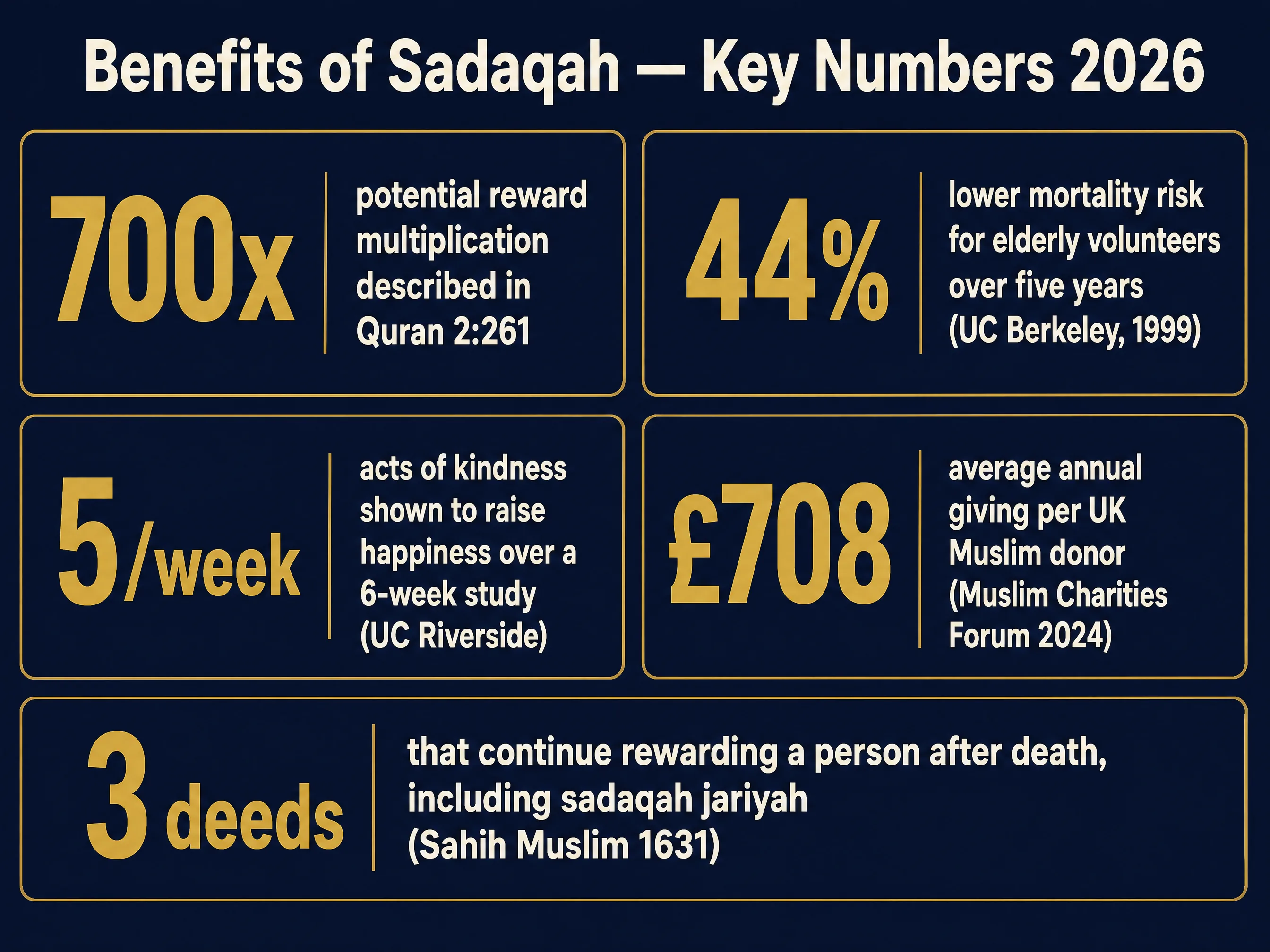
- Sadaqah's reward is multiplied "like a seed that grows seven spikes, each bearing a hundred grains" — up to 700 times — per Quran 2:261.
- "Sadaqah extinguishes sins just as water extinguishes fire" (Jami' at-Tirmidhi 614).
- Giving secretly earns shade on the Day of Judgment, per a hadith agreed upon by Bukhari and Muslim (Sahih al-Bukhari 1423).
- People who spent money on others reported measurably greater happiness than those who spent it on themselves, per Harvard Business School research (Michael Norton, 2008).
- Elderly adults who volunteered for two or more organisations were 44% less likely to die over a five-year period than non-volunteers (Doug Oman, UC Berkeley, 1999).
- Giving activates the same brain regions as receiving a reward, producing a "warm glow" effect — documented by NIH neuroscientist Jorge Moll (2006).
- Sadaqah jariyah — ongoing charity like HNCO's water wells — keeps its reward flowing even after the giver's death (Sahih Muslim 1631).
What are the spiritual benefits of sadaqah?
The core spiritual benefits of sadaqah, drawn directly from the Quran and hadith, cluster around four themes: multiplied reward, forgiveness, protection, and freedom from fear. "Those who spend their wealth in charity day and night, secretly and openly... their reward is with their Lord, and there will be no fear for them, nor will they grieve" (Quran 2:274). Sadaqah is also described as a path to taqwa — righteousness — since "you will never achieve righteousness until you spend from that which you love" (Quran 3:92).
Why does the Quran say sadaqah multiplies your reward?
The clearest statement of this is the parable in Quran 2:261: "The example of those who spend their wealth in the way of Allah is like a seed which grows seven spikes; in each spike is a hundred grains" — a multiplication of up to 700 times, with Allah multiplying further for whom He wills. It's a deliberately vivid image, not a literal financial formula, but it's the reason sadaqah is so often described as an investment rather than a loss.
A second, related benefit addresses a common hesitation directly: giving doesn't leave you poorer. "Charity does not decrease wealth," the Prophet ﷺ said, in a hadith graded sahih (Sahih Muslim 2588).
For the rules that distinguish voluntary giving from the annual obligation, read HNCO's guide to the difference between Zakat and Sadaqah.
Does giving sadaqah protect you from harm or calamity?
Two specific protections are named in hadith evidence. First, "Sadaqah extinguishes sins just as water extinguishes fire" (Jami' at-Tirmidhi 614) — sadaqah is described as actively wiping out wrongdoing, not merely balancing it. Second, a person "who gives in charity so secretly that his left hand does not know what his right hand has given" is named among seven people who will receive Allah's shade on the Day of Judgment, "a Day when there will be no shade but His" (Sahih al-Bukhari 1423, agreed upon).
A third, longer-running benefit applies specifically to sadaqah jariyah — ongoing charity such as a water well or a mosque. The Prophet ﷺ said a person's deeds end at death except three, including "a continuing charity" (Sahih Muslim 1631) — meaning the reward keeps accruing long after the original gift.
Is there scientific evidence for the benefits of giving?
Yes — and it's more specific than most people expect. Harvard Business School researcher Michael Norton found in a 2008 study that participants who spent money on others reported greater happiness than those who spent the same amount on themselves. NIH neuroscientist Jorge Moll's 2006 research found that giving activates brain regions linked to pleasure, social connection, and trust — often described as a "warm glow" effect. UC Riverside psychologist Sonja Lyubomirsky found that performing five acts of kindness a week over six weeks measurably increased participants' happiness (Greater Good Science Center, UC Berkeley).
What are the health benefits of giving sadaqah?
The health evidence is specific and comes from named, dated studies. UC Berkeley researcher Doug Oman found in 1999 that elderly adults who volunteered for two or more organisations were 44% less likely to die over a five-year period than non-volunteers. Stony Brook University's Stephen Post found that giving improved health outcomes in people managing chronic illnesses, including HIV and multiple sclerosis. Johns Hopkins researcher Rachel Piferi and University of Tennessee's Kathleen Lawler found in a 2006 study that people who provided social support to others had lower blood pressure than those who didn't (Greater Good Science Center, UC Berkeley).
How does sadaqah benefit the wider community, not just the giver?
Sadaqah's benefits aren't confined to the giver — that's arguably the point. A well funds clean water for a community for years; a masjid contribution builds a place of worship serving generations; orphan sponsorship supports a child's care over time. HNCO's own water well projects, masjid building, and orphan sponsorship in Pakistan and Kenya are structured specifically around this compounding, community-wide benefit — which is also why sadaqah jariyah given online tends to focus on infrastructure rather than one-off relief.
British Muslims donated an estimated £1.48bn–£2.22bn in 2024, averaging £708 per donor — four times the national average — showing that giving at this scale genuinely moves resources into communities that need them (Muslim Charities Forum, 2025).
How can you start benefiting from giving sadaqah today?
There's no minimum amount and no fixed schedule — that's what makes sadaqah accessible regardless of income. A practical starting point is HNCO's sadaqah calculator, or the guide to setting up monthly sadaqah if you'd rather give consistently than in one lump sum. If you're giving on behalf of someone else, see the guides to sadaqah as a gift for someone living and sadaqah jariyah gifts for weddings and birthdays. And before donating to any organisation for the first time, HNCO's own guide on how to verify an Islamic charity in the UK is worth reading first.
Benefits of sadaqah — spiritual and scientific evidence at a glance
| Benefit | Evidence | Source |
|---|---|---|
| Reward multiplied up to 700x | "A seed which grows seven spikes; in each spike is a hundred grains" | Quran 2:261 |
| Sins extinguished | "Sadaqah extinguishes sins just as water extinguishes fire" | Jami' at-Tirmidhi 614 |
| Freedom from fear and grief | "There will be no fear for them, nor will they grieve" | Quran 2:274 |
| Shade on the Day of Judgment | Hadith naming secret givers among seven shaded by Allah | Sahih al-Bukhari 1423 |
| Greater happiness | Spending on others measurably increased happiness vs spending on self | Harvard Business School (Norton, 2008) |
| Lower mortality risk (-44%) | Elderly volunteers for 2+ organisations over five years | UC Berkeley (Oman, 1999) |
| Reward continues after death | Sadaqah jariyah named among three deeds that outlive a person | Sahih Muslim 1631 |
Put the Benefits of Sadaqah to Work
Fund a water well, a masjid contribution, or a forever donation — spiritual reward, ongoing community benefit.
Give Sadaqah NowBenefits of Sadaqah — Frequently Asked Questions
What are the main benefits of sadaqah?
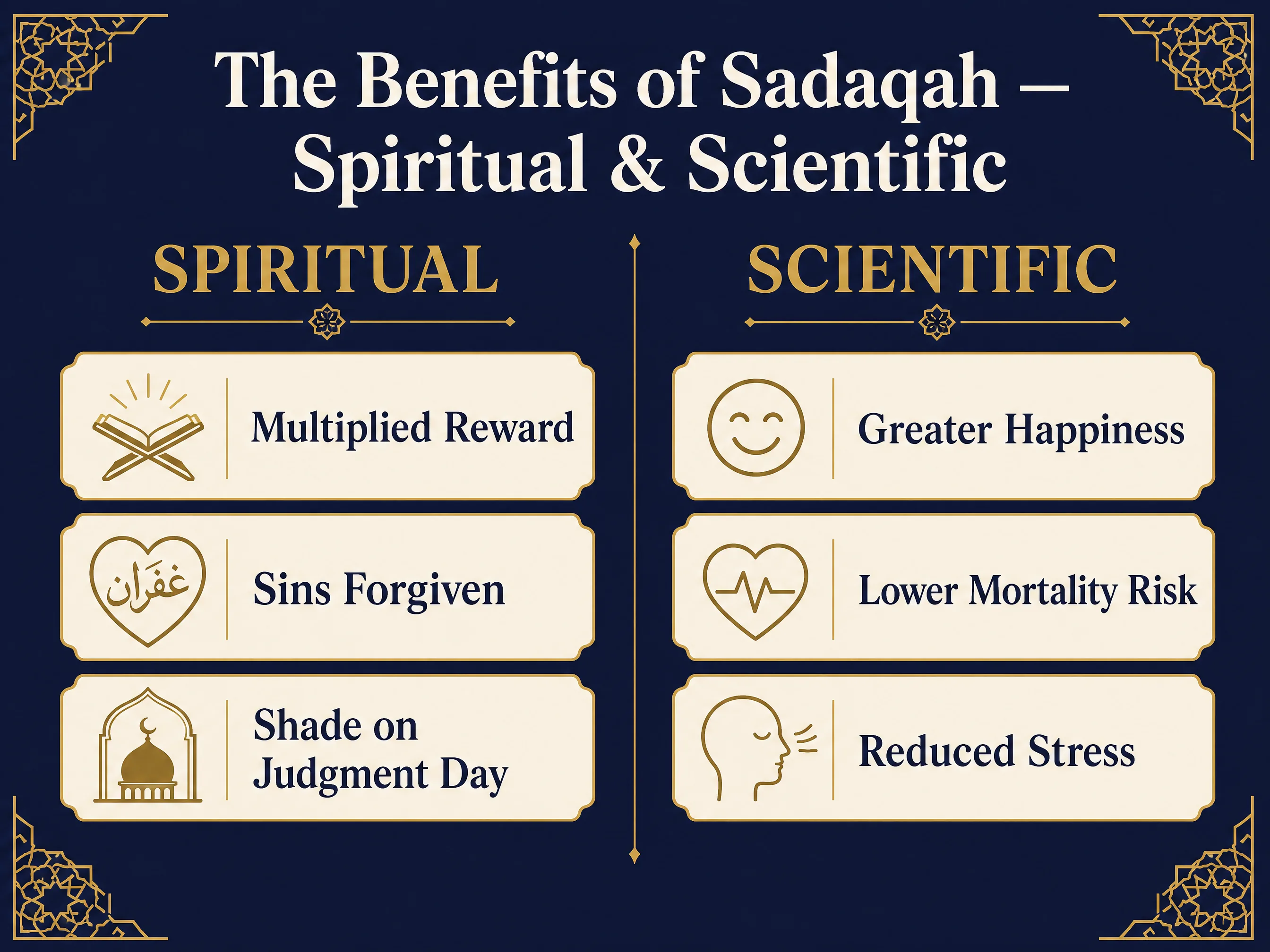
The main benefits described in the Quran and hadith are multiplied reward (up to 700 times, per Quran 2:261), the extinguishing of sins, freedom from fear and grief, and shade on the Day of Judgment. Peer-reviewed research also links giving generally to greater happiness, lower mortality risk, and reduced stress.
Does sadaqah really multiply your reward 700 times?
The Quran describes it with a parable — a seed that grows seven spikes, each bearing a hundred grains — in Quran 2:261, with Allah multiplying further for whom He wills. It's understood as a description of reward, not a literal financial formula.
Is there scientific evidence that giving benefits the giver?
Yes. Harvard Business School research (Michael Norton, 2008) found people who spent money on others reported greater happiness than those who spent it on themselves, and UC Berkeley research (Doug Oman, 1999) found elderly volunteers were 44% less likely to die over a five-year period.
What is the benefit of giving sadaqah in secret?
A person who gives charity so secretly that “his left hand does not know what his right hand has given” is named among seven people who will receive Allah's shade on the Day of Judgment (Sahih al-Bukhari 1423, agreed upon).
What is the benefit of sadaqah jariyah specifically?
Sadaqah jariyah — ongoing charity such as a water well or a mosque — keeps its reward flowing after the giver's death, named among only three deeds that continue benefiting a person after death (Sahih Muslim 1631).
Does giving sadaqah reduce how much wealth you have?
According to a hadith graded sahih in Sahih Muslim, charity does not decrease wealth — a statement understood as both a spiritual and, many argue, practical principle.
Can non-Muslims benefit from the research on giving too?
Yes — the happiness, health, and stress-reduction research cited above (Harvard, NIH, UC Berkeley, Johns Hopkins) studied giving generally, not specifically religious giving, so the wellbeing benefits apply regardless of faith.