
We value your privacy

    We use cookies to enhance your browsing experience and analyse site traffic. You can accept all, reject non-essential, or customise your choice. Read our Cookie Policy.

    HNCO
    Locate Address:

    Nelson, BB95FL

    Call us any time:

    01282501998

    Email us any time:

    info@hnco.org.uk

    My Donations
    Wudu Steps with Pictures — Illustrated Guide
    HNCO · Wudu Guides

    Wudu Steps with Pictures — Illustrated Guide

    Wudu steps with pictures: illustrated guide to Islamic ablution showing all 9 steps with inline diagrams. Covers the 4 fard acts, sunnah steps, and closing dua.

    GIVE CLEAN WATER

    or choose a custom amount
    £

    Live community appeal

    Solar Pump #17 in progress

    £69 raised of £1800

    4% funded · £1731 to go

    4 donors have contributed so far

    Jazak Allahu Khairan to our recent donors 🤲

    Mohammad C., Maliha H., Sadia

    Thank you for your continued support — may Allah accept it.

    Wudu steps with pictures: nine illustrated steps for performing Islamic ablution correctly. The four fard (obligatory) acts — washing the face, washing the arms to the elbows, wiping the head (masah), and washing the feet to the ankles — are shown in sequence. All other steps are strongly recommended sunnah acts that multiply reward. Every fard body part must be completely covered with water for wudu to be valid.

    Key Takeaways

    • 4 fard acts from Quran 5:6 — face, arms to elbows, head (masah), feet to ankles
    • Each fard body part must be covered — a dry spot the size of a fingernail invalidates wudu
    • Wash each fard area at least once; the Sunnah is three times
    • Masah (head wipe) is done once only — not three times
    • Right side first for arms and feet — sunnah of the Prophet ﷺ
    • The wudu is sourced from Sahih al-Bukhari 164 — the primary demonstrated hadith
    • Water must be pure and unaltered — cannot use juice, milk, or contaminated water

    What do the wudu steps look like — illustrated guide

    Each step below includes a diagram showing the body part being washed and the technique. Steps marked FARD are obligatory; steps marked SUNNAH are strongly recommended.

    Step 1 — Intention (niyyah) and Bismillah Sunnah
    Before touching any water: form the intention in your heart that you are performing wudu for the sake of Allah. Say Bismillah. The hands shown represent the readiness to begin. Neither the intention nor bismillah needs to be spoken aloud — the internal resolve is sufficient.
    Step 2 — Wash both hands to the wrists Sunnah
    Cup water and wash the right hand from fingertips to wrist three times, cleaning between each finger. Repeat with the left hand. The hands must be clean before they contact the face and other body parts. Remove any substance (nail polish, paint, dough) that prevents water reaching the skin.
    Step 3 — Rinse mouth (madmadah) and clean nose (istinshaq) Sunnah mu'akkadah
    Take a handful of water in the right hand and rinse the mouth thoroughly three times, swirling to reach all surfaces. Then sniff water into both nostrils three times, expelling gently with the left hand. The Prophet ﷺ said: "Whoever performs wudu, let him put water in his nose." (Bukhari 162) These two acts together use three handfuls of water.
    Step 4 — Wash the face FARD
    Place both wet hands on the forehead (at the hairline) and wash downward to below the chin. Width: from earlobe to earlobe. Wash three times. The entire face must be covered — no part may remain dry. Men with thick beards wash the beard surface; thin beards require water to reach the skin beneath. Remove waterproof makeup before this step.
    Step 5 — Wash both arms to the elbows FARD
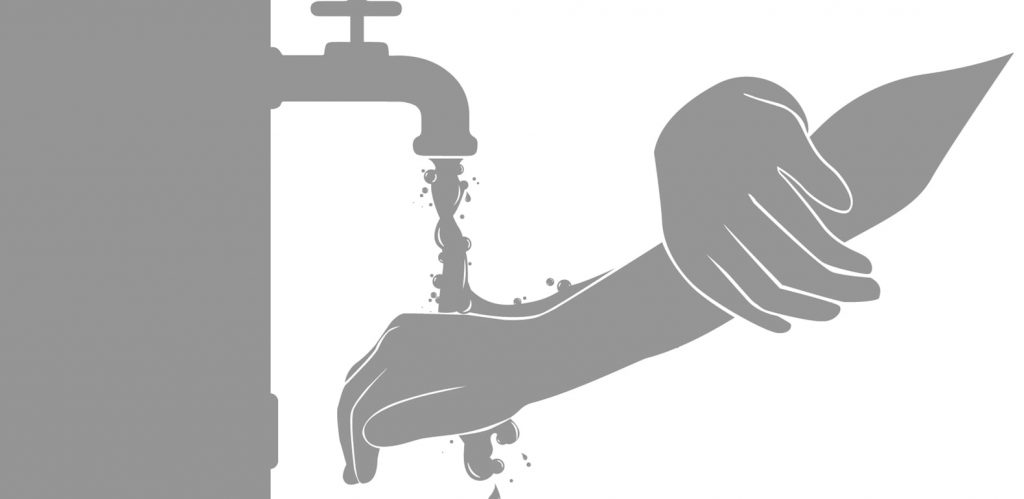
    Right arm first: wash from fingertips to and including the elbow three times. Water must cover the elbow itself — not just up to it. Then left arm. Roll up sleeves. Move rings and bangles to ensure no dry skin beneath them. Not a single hair may remain dry from fingertip to elbow.
    Step 6 — Wipe the head (masah) FARD
    Wet both hands with fresh water. Place fingers at the front hairline and sweep backward to the nape of the neck. Then sweep forward again — this is one masah. Done once only — not three times. The minimum amount varies by school: ¼ head (Hanafi), any portion (Shafi'i), full head (Maliki, Hanbali). Women do not need to undo braids — wipe the surface.
    Step 7 — Wipe the ears Sunnah
    Using the water remaining on the hands from the masah (step 6), insert the index fingers into the ear canals and wipe the outer ear surface with the thumbs. Done once. This step immediately follows the masah — it uses the same water, not fresh water.
    Step 8 — Wash both feet to the ankles FARD
    Right foot first: wash from the toes to and including the ankle three times. Use the little finger (of the left hand) to clean between each toe — start from the little toe and work across. Then left foot. Pay particular attention to heels and the back of the ankles — these are the most frequently missed areas. Toenail polish must be removed; ankle socks or henna are fine.
    Step 9 — Closing dua Sunnah mu'akkadah
    After drying, face the qibla and recite: Ashhadu an la ilaha illallahu wahdahu la sharika lah, wa ashhadu anna Muhammadan 'abduhu wa rasuluh.
    I bear witness that none has the right to be worshipped but Allah alone, without partner, and I bear witness that Muhammad is His slave and Messenger.The Prophet ﷺ said the eight gates of Jannah are opened for whoever recites this — Sahih Muslim 234.

    Which wudu steps are fard and which are sunnah?

    Step Type Consequence if omitted
    Niyyah / bismillah Sunnah (Hanafi) / Fard (others) Hanafi: wudu valid; other schools: invalid without niyyah
    Wash hands Sunnah Wudu valid; reward reduced
    Rinse mouth + nose Sunnah mu'akkadah Wudu valid; significant sunnah missed
    Wash face Fard Wudu invalid — must repeat
    Wash arms to elbows Fard Wudu invalid — must repeat
    Wipe head (masah) Fard Wudu invalid — must repeat
    Wipe ears Sunnah Wudu valid; reward reduced
    Wash feet to ankles Fard Wudu invalid — must repeat
    Closing dua Sunnah mu'akkadah Wudu valid; major reward missed

    What are the most common wudu mistakes to watch for?

    • Dry elbow: washing the arm "to" the elbow without washing the elbow itself — the elbow is included in the fard
    • Dry heel: water running over the top of the foot without reaching the back of the heel
    • Between the toes: toes pressed together prevent water penetrating — actively clean each gap
    • Three masahs: the head masah is done once only — wiping three times is against the Sunnah
    • Wiping over nail polish: standard polish blocks the nail — a fard area must be fully washed
    • Ear water: using fresh water for the ears rather than the remaining water from the masah — the sunnah is to use the same water

    Frequently asked questions about wudu steps with pictures

    What are the wudu steps with pictures?

    The 9 illustrated steps: (1) niyyah + bismillah, (2) wash hands, (3) rinse mouth and nose, (4) wash face (fard), (5) wash arms to elbows (fard), (6) wipe head/masah (fard), (7) wipe ears, (8) wash feet to ankles (fard), (9) closing dua. The four fard acts are non-negotiable for validity.

    What does wudu look like in pictures?

    Cupped hands for the mouth rinse; nose pinched and expelled; face covered with both palms; forearms under running water; wet palms sweeping from forehead to nape; fingers in ears; and feet lifted with water actively running over them. Each fard body part must be completely wet.

    How do you do wudu step by step?

    Intention → bismillah → wash hands → mouth → nose → wash face (fard) → wash arms to elbows (fard) → wipe head (fard) → wipe ears → wash feet (fard) → closing dua. The four fard acts in bold are obligatory — the rest are sunnah.

    How many times do you wash each body part in wudu?

    The fard minimum is once per body part — wudu is valid after a single wash of each fard area. The Sunnah is three times for the face, arms, and feet. The head masah is done exactly once — not three times.

    Do you dry yourself after wudu?

    Drying is permitted — it does not invalidate wudu. There is a difference of opinion on whether drying is disliked (makruh): Maliki scholars discourage it as wasting the blessing of the water; other schools have no objection. In any case, drying does not break wudu.

    Can wudu be done with warm water?

    Yes — water temperature does not affect wudu's validity. Warm, cold, or room-temperature water are all equally valid. The only condition is that the water is pure (tahir) and unaltered in colour, smell, or taste by a najasa (impure substance).

    Related reading: Wudu step by step (text guide) · Order of wudu · Wudu for females · What is wudu? · Donate clean water

    Methodology: all steps sourced to Quran 5:6 and Sahih al-Bukhari 164. Diagrams are original inline SVG illustrations. No photographs or third-party images. YMYL religious guidance — last reviewed June 2026.

    HNCO — Hajjah Naziha Charitable Organisation
    UK non-profit organisation dedicated to Islamic education and humanitarian aid. About HNCO →
    Continue exploring

    More in Wudu