
What is the iftar dua? The authentic iftar dua is "Dhahaba al-ẓamaʾu wabtallatil-ʿurūqu wa thabatal-ajru in shāʾ Allāh": "Thirst has gone, the veins are moist, and the reward is sure, if Allah wills." The Prophet said it when breaking his fast (Abu Dawud 2357, graded hasan).
Key Takeaways
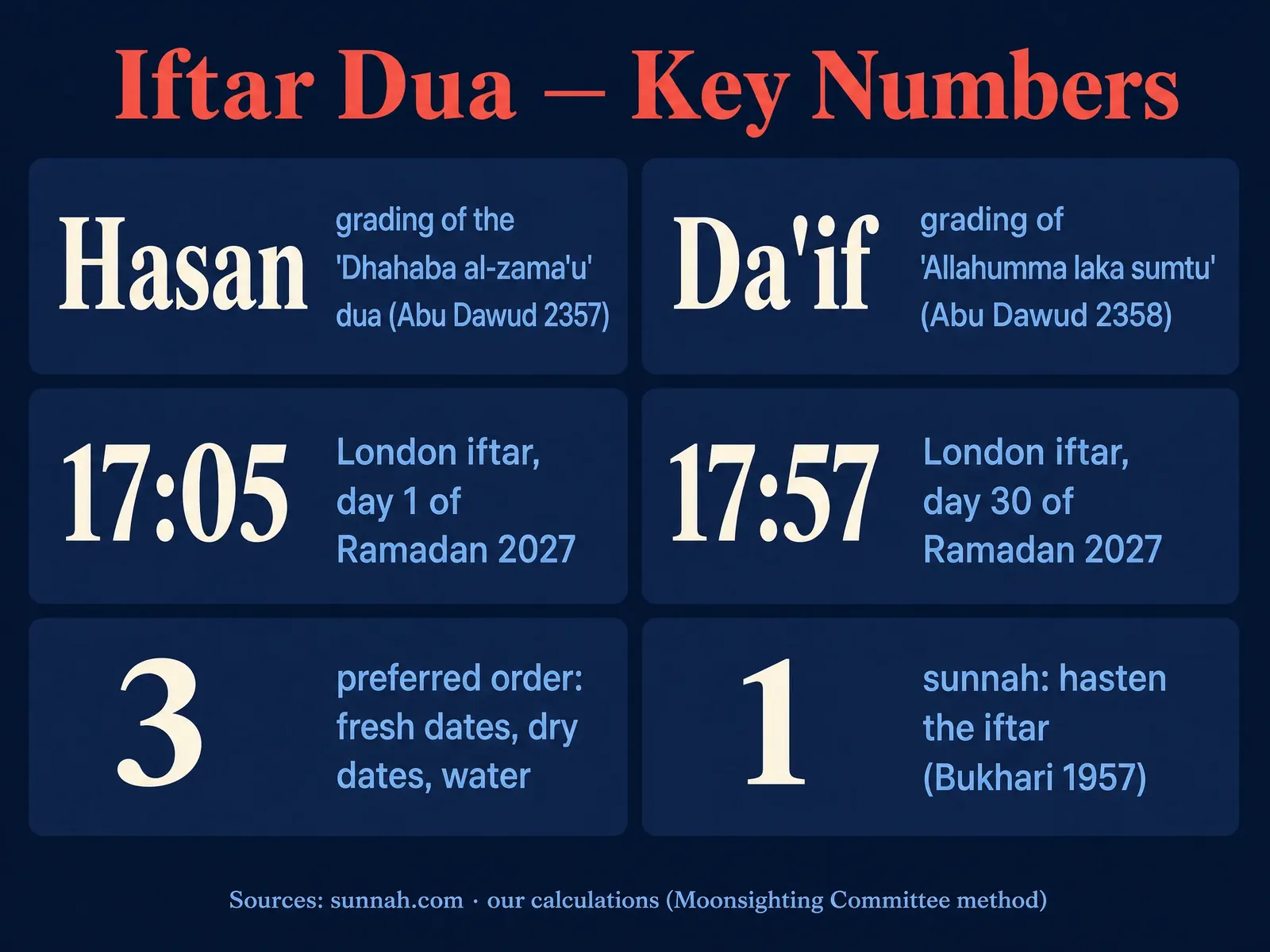
- The iftar dua "Dhahaba al-ẓamaʾu..." is reported from Ibn Umar and graded hasan by al-Albani (Abu Dawud 2357).
- The well-known "Allāhumma laka ṣumtu wa ʿalā rizqika afṭartu" is graded da'if (weak) by al-Albani (Abu Dawud 2358).
- The Prophet broke his fast with fresh dates, then dry dates, then water (Abu Dawud 2356).
- Hastening the iftar is a sunnah: people "will remain on the right path as long as they hasten the breaking of the fast" (Bukhari 1957).
- In London, iftar in Ramadan 2027 runs from 17:05 on day 1 to 17:57 on day 30 by our calculation (London timetable).
What is the iftar dua in Arabic?
This is the iftar dua with the strongest chain, recorded in Sunan Abi Dawud from Ibn Umar.
Transliteration: Dhahaba al-ẓamaʾu wabtallatil-ʿurūqu wa thabatal-ajru in shāʾ Allāh.
Meaning: "Thirst has gone, the arteries are moist, and the reward is sure, if Allah wills." (sunnah.com translation, Abu Dawud 2357)
Marwan ibn Salim reported seeing Ibn Umar relate that the Prophet said this when he broke his fast. Al-Albani graded it hasan (good), which is enough for it to be acted on.
Is "Allahumma laka sumtu" an authentic iftar dua?
"Allāhumma laka ṣumtu wa ʿalā rizqika afṭartu" is the most widely printed iftar dua, but its chain is weak. It is reported by Mu'adh ibn Zuhrah, who was not a companion, and al-Albani graded it da'if (Abu Dawud 2358).
Transliteration: Allāhumma laka ṣumtu wa ʿalā rizqika afṭartu.
Meaning: "O Allah, for Thee I have fasted, and with Thy provision I have broken my fast." (sunnah.com translation)
Its meaning is sound, so many scholars say there is no harm in saying it as a general dua. Just don't treat it as the confirmed words of the Prophet.
| Dua | Reference | Narrator | Grading (al-Albani) | When |
|---|---|---|---|---|
| Dhahaba al-ẓamaʾu wabtallatil-ʿurūq... | Abu Dawud 2357 | Ibn Umar (via Marwan ibn Salim) | Hasan | After breaking the fast |
| Allāhumma laka ṣumtu... | Abu Dawud 2358 | Mu'adh ibn Zuhrah | Da'if | At iftar (general dua) |
| Bismillah | General sunnah of eating | — | Established | Before the first bite |
When do you say the iftar dua: before or after eating?
The wording of "Dhahaba al-ẓamaʾu" ("thirst has gone") shows it is said after the first sip or date, once the fast has actually been broken. Say "Bismillah" as you start, break the fast, then say the dua.
Many families break the fast with a few dates and water, pray Maghrib, and then sit down for the main meal. That keeps the sunnah of hastening the iftar without delaying the prayer.
What should you break your fast with?
The sunnah is to break the fast with fresh dates, or dry dates if there are none, or a few sips of water. Anas ibn Malik described the Prophet doing exactly this, and al-Albani graded the report hasan sahih (Abu Dawud 2356).
In the UK, where fresh dates are rare in February and March, dried dates such as Medjool or Ajwa are the norm. Our iftar recipes cover what to eat after that first date.
What time is iftar in the UK in Ramadan 2027?
Iftar is at Maghrib, just after sunset, so it gets later through the month. In Ramadan 2027 it moves by roughly 50 minutes between the first and last day in most UK cities.
| City | Iftar day 1 (8 Feb) | Iftar day 30 (9 Mar) |
|---|---|---|
| London | 17:05 | 17:57 |
| Birmingham | 17:10 | 18:04 |
| Manchester | 17:08 | 18:04 |
| Bradford | 17:05 | 18:02 |
| Leicester | 17:06 | 18:01 |
| Glasgow | 17:08 | 18:11 |
For today's time wherever you are, use iftar time today. Your mosque may add a minute or two of caution after sunset.
Is dua at iftar more likely to be accepted?
Many Muslims make extra dua in the minutes before and after iftar, because the moment of breaking the fast is traditionally seen as a time when the fasting person's dua is answered. Use the time for personal duas in any language as well as the iftar dua itself.
Other duas for the month are in our guides to the sehri dua, the taraweeh dua and Ramadan duas.
Iftar dua: frequently asked questions
What is the authentic dua for breaking the fast?
"Dhahaba al-ẓamaʾu wabtallatil-ʿurūqu wa thabatal-ajru in shāʾ Allāh" (Abu Dawud 2357, graded hasan).
Is "Allahumma laka sumtu" authentic?
Its chain is weak (Abu Dawud 2358, graded da'if). Its meaning is sound, so many scholars allow it as a general dua.
Do you say the iftar dua before or after eating?
After breaking the fast. Say Bismillah first, take a date or water, then say the dua.
What is the English meaning of the iftar dua?
"Thirst has gone, the veins are moist, and the reward is sure, if Allah wills."
What should I break my fast with?
Fresh dates, or dry dates, or water, following Abu Dawud 2356.
What time is iftar in London in Ramadan 2027?
About 17:05 on 8 February, rising to about 17:57 by 9 March, by our calculation.
Can I make dua in English at iftar?
Yes. Personal dua can be made in any language.