
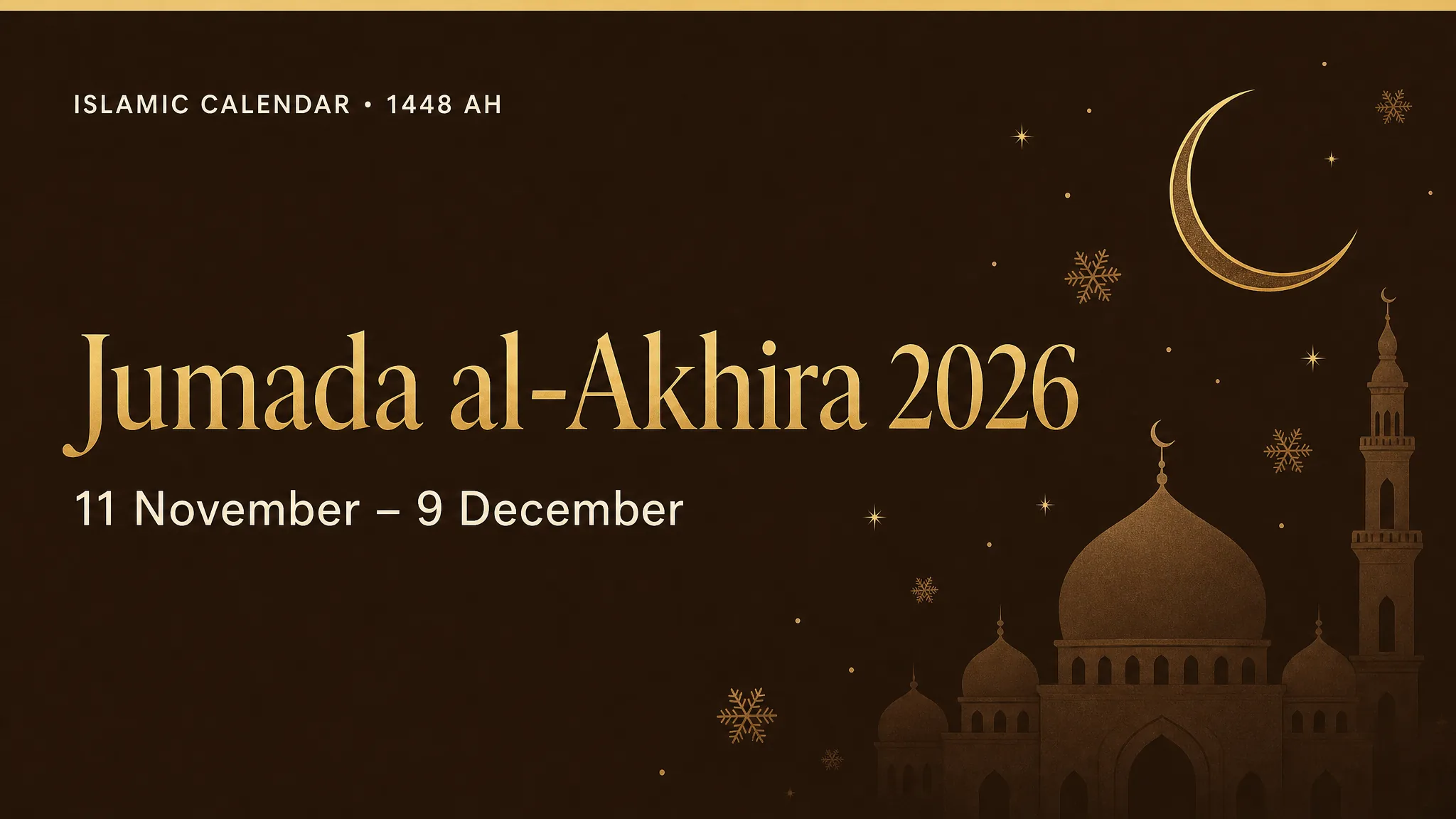
Jumada al-Akhira 2026 runs from approximately 11 November to 9 December 2026 (1448 AH), subject to moon sighting. It is the sixth month of the Islamic calendar — the last quiet month before the sacred month of Rajab, and the month in which Abu Bakr, the first caliph, passed away.
Key Takeaways
- Jumada al-Akhira 1448 AH begins on approximately Wednesday 11 November 2026 and ends around 9 December 2026, subject to local moon sighting — see the full Islamic calendar for 2026.
- The name means "the last Jumada", from the Arabic jamad — dry, parched or frozen — pairing it with Jumada al-Ula before it (Wikipedia). It is the 6th month, also written Jumada al-Thani or Jumada II.
- Abu Bakr al-Siddiq, the first caliph and the Prophet's ﷺ closest companion, passed away on 22 Jumada al-Akhira 13 AH (634 CE) — approximately 2 December in 2026 (Wikipedia).
- The White Days (13th–15th) fall on approximately 23–25 November 2026. The Prophet ﷺ said fasting them "is like keeping perpetual fast" (Sunan Abi Dawud 2449, sahih).
- The Prophet ﷺ said: "When a man dies, his acts come to an end, but three: recurring charity, or knowledge (by which people) benefit, or a pious child, who prays for him" (Sahih Muslim 1631).
- Around 3.9 million Muslims in England and Wales (ONS Census 2021) will mark the month as UK winter charity appeals begin.
When is Jumada al-Akhira 2026?
Jumada al-Akhira 2026 begins on approximately Wednesday 11 November 2026, which corresponds to 1 Jumada al-Akhira 1448 AH in calculated Hijri calendars such as AlAdhan and IslamicFinder. Because Islamic days start at sunset, the month actually enters on the evening of Tuesday 10 November.
The month runs for 29 or 30 days, ending on approximately 9 December 2026 — and what follows is no ordinary month: Rajab, one of the four sacred months, begins around 10 December. As always, exact dates depend on the sighting of the new crescent moon and can shift by a day between countries and communities.
| Date (Jumada al-Akhira 1448 AH) | Expected Gregorian date | What it marks |
|---|---|---|
| 1st | Wednesday 11 November 2026 | Jumada al-Akhira 2026 begins (evening of 10 November) |
| 13th–15th | 23–25 November 2026 | The White Days — recommended voluntary fasts |
| 22nd (13 AH) | c. 2 December 2026 | Anniversary of the passing of Abu Bakr al-Siddiq |
| 29th/30th | c. 9 December 2026 | Month ends; the sacred month of Rajab begins |
All dates are subject to moon sighting and may vary by location and community.
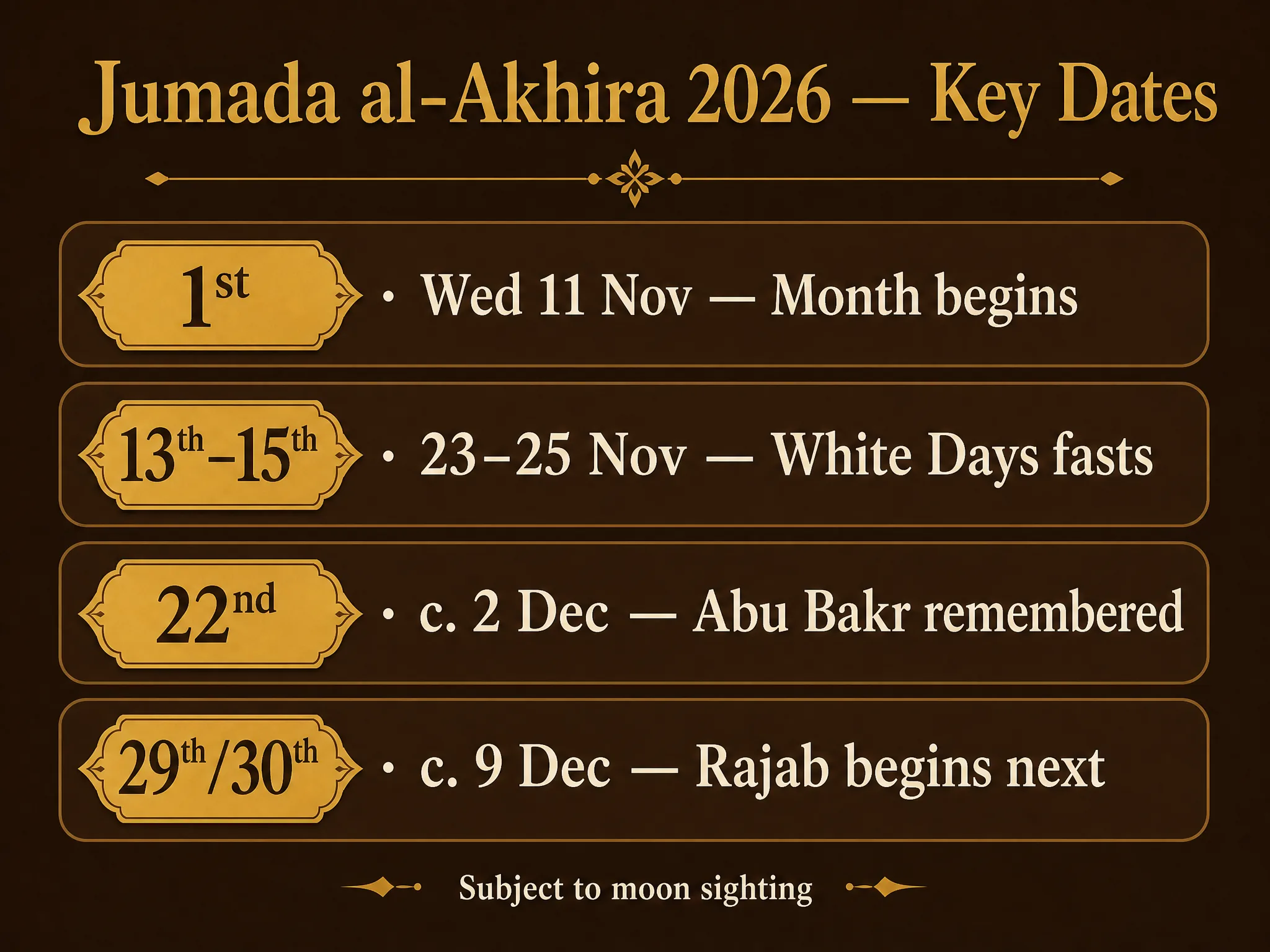
All the key dates at a glance — each subject to moon sighting.
What does Jumada al-Akhira mean?
Jumada al-Akhira (جمادى الآخرة) means "the last Jumada" — the second of the two Jumada months, from the Arabic root jamad: dry, parched land, or by some accounts water freezing in the pre-Islamic Arabian winter (Wikipedia).
You will also see it written as Jumada al-Thani ("the second Jumada"), Jumada II or, in South Asian usage, Jumadi-us-Sani — all the same month. It is the sixth month of the Hijri calendar, closing the first half of the Islamic year that began with Muharram and the Islamic New Year in June.
In 2026 the month spans late November into early December for UK Muslims — short days, long nights, and the natural close of the year's quietest stretch before Rajab opens the run-up to Ramadan.
What happened in Jumada al-Akhira?
The month's defining anniversary is the passing of Abu Bakr al-Siddiq on 22 Jumada al-Akhira 13 AH (August 634 CE). The Prophet's ﷺ closest friend, his companion in the cave during the Hijrah, and the first caliph, Abu Bakr led the community for just over two years — steering it through the wars of apostasy and beginning the compilation of the Qur'an into a single volume (Wikipedia).
Other dates recorded in this month include the death of the Abbasid caliph Harun al-Rashid on the 3rd, and Saladin becoming amir of Egypt on the 25th (564 AH). Shia Muslims mark the birth of Fatimah, the Prophet's ﷺ daughter, on the 20th; her passing in 11 AH is placed by some accounts on the 3rd of this month, though other narrations place it earlier in the year.
Abu Bakr's legacy gives the month its quiet theme. He was famous for his giving — when he brought everything he owned for the Tabuk expedition and was asked what he had left for his family, he replied that he had left them Allah and His Messenger. For most communities, though, none of these dates carries a prescribed observance.
How do Muslims observe Jumada al-Akhira 2026?
There are no acts of worship specific to this month. Its value lies in keeping the ordinary sunnah devotions going — the deeds the Prophet ﷺ described as the most beloved to Allah, "the most regular and constant even if it were little" (Sahih al-Bukhari 6464).
Common observances this month include:
- Fasting the White Days — the 13th, 14th and 15th of the Hijri month, falling on approximately 23–25 November 2026. The Prophet ﷺ said of them: "This is like keeping perpetual fast" (Sunan Abi Dawud 2449, graded sahih). With UK sunset before 4pm in late November, these are the shortest voluntary fasts of the year.
- Fasting Mondays and Thursdays — "Deeds are presented on Monday and Thursday, and I love that my deeds be presented while I am fasting" (Jami' at-Tirmidhi 747, hasan).
- A steady Qur'an and dhikr portion — and with Rajab and then Ramadan approaching, many use this month to settle the routine they want to carry into the sacred season.
- Studying the life of Abu Bakr — his anniversary makes the month a natural time for study circles on the first caliph's character and generosity.
- Giving charity — including sadaqah and zakat, as winter appeals reach their height.
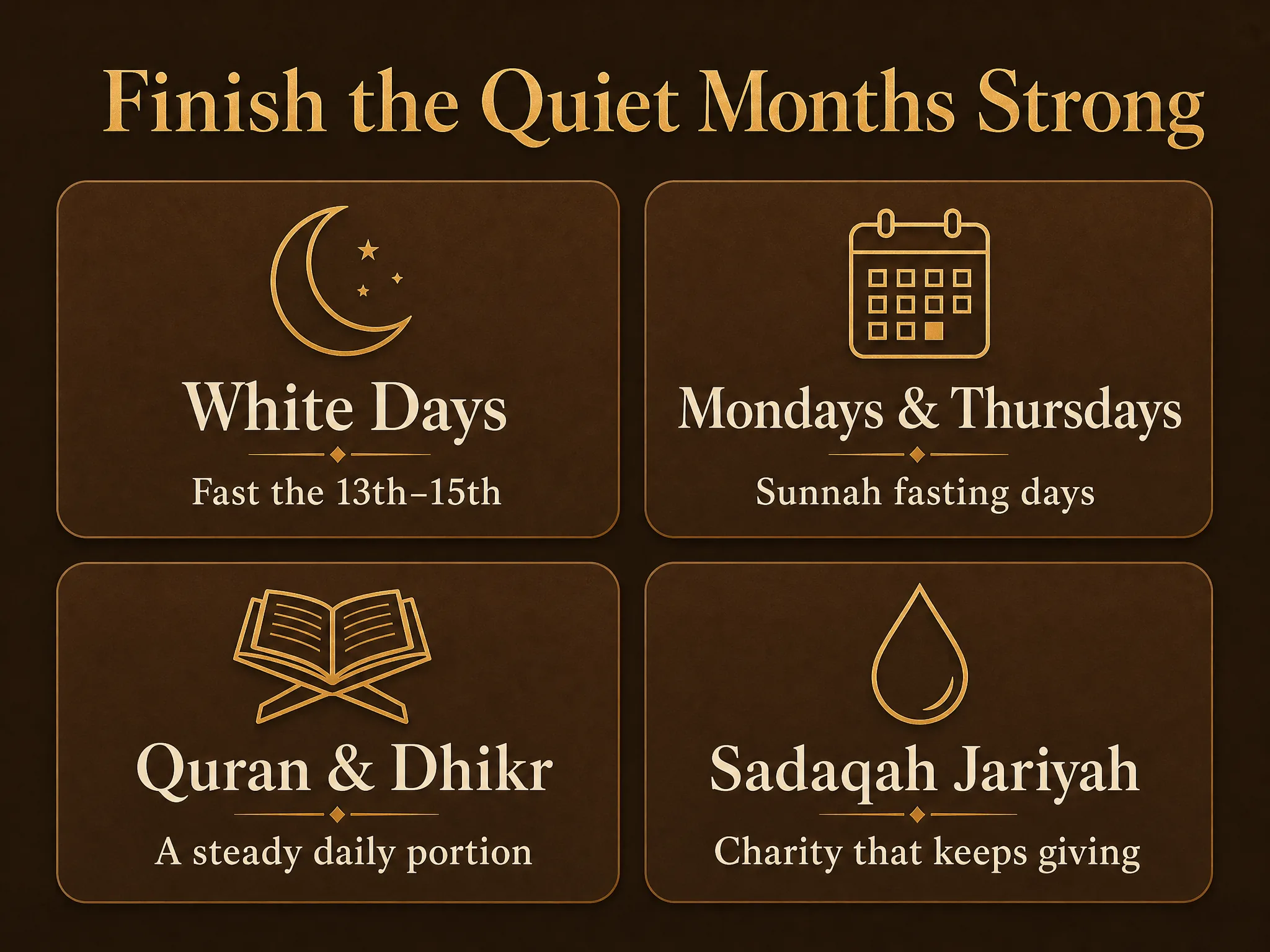
The four steady practices — finishing the quiet months strong.
Why does this month matter before Rajab?
Jumada al-Akhira is the last ordinary month for a while. Rajab — one of the four sacred months — follows immediately, then Sha'ban, then Ramadan. The believer who wants to arrive at Ramadan with habits already in place builds them now, in the month with no spotlight on it.
Abu Bakr's example points the same way. His deeds outlived him — the community he stabilised, the Qur'an compilation he began — which is precisely the promise of the Prophet's ﷺ words:
That "recurring charity" — sadaqah jariyah — is charity built to keep working: a well that keeps flowing, a masjid that keeps serving, knowledge that keeps spreading.
Why give charity in Jumada al-Akhira?
For UK Muslims the month lands exactly when winter hardship peaks abroad and appeals open at home. At HNCO, a UK non-profit organisation, donations most often go towards clean water projects and masjid construction in Pakistan — both classic forms of sadaqah jariyah, and both zakat-eligible.
Leave a Deed That Outlives You
Close the quiet months with charity that keeps giving — a water well, a masjid, or an ongoing forever donation.
Donate Now Build a Water WellHow is the start of the month decided?
Like every Hijri month, it begins with the new crescent moon. Two approaches exist side by side: Saudi Arabia's Umm al-Qura calendar fixes dates in advance by astronomical calculation, while many communities — including many UK mosques — wait for a verified local or regional sighting.
In practice this means the dates in this guide, drawn from calculated calendars such as AlAdhan's 1448 AH tables, may differ by a day from your mosque's announcement. When the precise date matters — for example, planning the White Days fasts or the first fast of Rajab — always confirm with your local mosque or Islamic authority.
Jumada al-Akhira 2026 — Frequently Asked Questions
When does Jumada al-Akhira 2026 start?
Jumada al-Akhira 2026 starts on approximately Wednesday 11 November 2026 (1 Jumada al-Akhira 1448 AH), entering from sunset on Tuesday 10 November. The exact date depends on the sighting of the new crescent moon.
Is Jumada al-Akhira the same as Jumada al-Thani?
Yes. Jumada al-Akhira ("the last Jumada"), Jumada al-Thani ("the second Jumada"), Jumada II and Jumadi-us-Sani are all names for the same month — the sixth month of the Islamic calendar.
What is the difference between Jumada al-Ula and Jumada al-Akhira?
They are the fifth and sixth months respectively — "the first" and "the last" of the two Jumada months, named for the dry or cold season in pre-Islamic Arabia. Jumada al-Ula 2026 ran from mid-October; Jumada al-Akhira follows it from approximately 11 November.
Is fasting required in Jumada al-Akhira?
No — there are no obligatory fasts in the sixth month. Recommended voluntary fasts include the White Days (13th–15th, approximately 23–25 November 2026) and Mondays and Thursdays.
What are the White Days in Jumada al-Akhira 2026?
The White Days are the 13th, 14th and 15th of every Hijri month, when the moon is fullest. In Jumada al-Akhira 1448 they fall on approximately 23–25 November 2026. The Prophet ﷺ described fasting them as being like keeping a perpetual fast (Sunan Abi Dawud 2449).
Who was Abu Bakr and why is he remembered this month?
Abu Bakr al-Siddiq was the Prophet's ﷺ closest companion and the first caliph of Islam. He passed away on 22 Jumada al-Akhira 13 AH (634 CE) after leading the community for just over two years, during which the compilation of the Qur'an into a single volume began.
What month comes after Jumada al-Akhira 2026?
Rajab — one of the four sacred months of the Islamic calendar — begins on approximately 10 December 2026, subject to moon sighting, opening the traditional run-up to Ramadan.
What is the best charity to give in Jumada al-Akhira?
Sadaqah jariyah — the "recurring charity" of Sahih Muslim 1631 — such as a water well or a masjid, whose reward continues after the giver's death. HNCO water wells in Pakistan start from £150, and all water projects are zakat-eligible.