
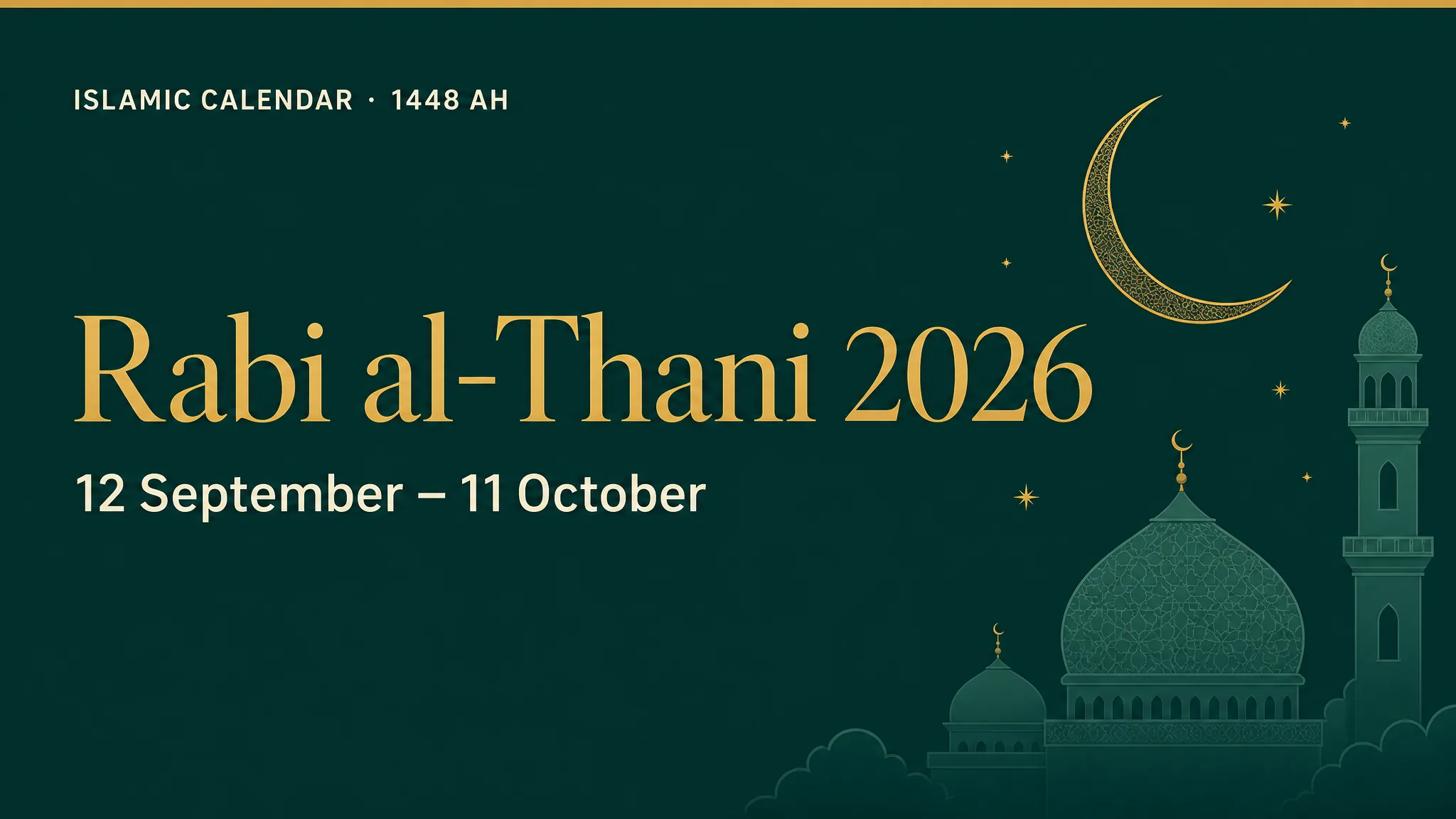
Rabi al-Thani 2026 runs from approximately 12 September to 11 October 2026 (1448 AH), subject to moon sighting. It is the fourth month of the Islamic calendar — a quiet month with no obligatory observances, traditionally used for steady voluntary worship, fasting and charity.
Key Takeaways
- Rabi al-Thani 1448 AH begins on approximately Saturday 12 September 2026 and ends around 11 October 2026, subject to local moon sighting — see the full Islamic calendar for 2026.
- Rabi al-Thani (ربيع الثاني) means "the second spring". It is the 4th month of the Hijri calendar, following Rabi al-Awwal, and is also called Rabi al-Akhir (Wikipedia).
- Gyarvi Sharif — the anniversary of Shaykh Abdul Qadir al-Jilani, observed on 11 Rabi al-Thani — falls on approximately Tuesday 22 September 2026 (UrduPoint).
- The White Days (13th–15th) fall on approximately 24–26 September 2026. The Prophet ﷺ said fasting them "is like keeping perpetual fast" (Sunan Abi Dawud 2449, sahih).
- There are no obligatory observances this month — the Prophet's ﷺ guidance is that "the most beloved deed to Allah is the most regular and constant even if it were little" (Sahih al-Bukhari 6464).
- Around 3.9 million Muslims in England and Wales (ONS Census 2021) will mark the month — many with voluntary fasts and sadaqah.
When is Rabi al-Thani 2026?
Rabi al-Thani 2026 begins on approximately Saturday 12 September 2026, which corresponds to 1 Rabi al-Thani 1448 AH in calculated Hijri calendars such as Hijri-Gregorian and AlAdhan. Because Islamic days start at sunset, the month actually enters on the evening of Friday 11 September.
The month runs for 29 or 30 days, ending on approximately 11 October 2026, when Jumada al-Ula begins. As with every Hijri month, the exact start and end depend on the sighting of the new crescent moon, so dates can shift by a day between countries — and even between mosques in the same UK city.
| Date (Rabi al-Thani 1448 AH) | Expected Gregorian date | What it marks |
|---|---|---|
| 1st | Saturday 12 September 2026 | Rabi al-Thani 2026 begins (evening of 11 September) |
| 11th | Tuesday 22 September 2026 | Gyarvi Sharif — anniversary of Shaykh Abdul Qadir al-Jilani |
| 13th–15th | 24–26 September 2026 | The White Days — recommended voluntary fasts |
| 27th | Thursday 8 October 2026 | Anniversary of Imam Rabbani Ahmad Sirhindi |
| 29th/30th | c. 11 October 2026 | Month ends; Jumada al-Ula begins |
All dates are subject to moon sighting and may vary by location and community.
All the key dates at a glance — each subject to moon sighting.
What does Rabi al-Thani mean?
Rabi al-Thani (ربيع الثاني) translates as "the second spring" — the companion to Rabi al-Awwal, "the first spring". The pair were named in pre-Islamic Arabia, when they coincided with the spring grazing season. The month is equally known as Rabi al-Akhir ("the last spring"), and in South Asian communities as Rabi ul Sani; Western sources sometimes write Rabi II (Wikipedia).
The month is the fourth of the Islamic Hijri calendar, arriving after Muharram, Safar and Rabi al-Awwal. Because the Hijri calendar is lunar and about 11 days shorter than the Gregorian year, the "spring" months drift through the seasons — in 2026 the second spring falls in the British autumn, three months after the Islamic New Year in June.
Unlike Ramadan or Dhul Hijjah, Rabi al-Thani carries no prescribed rituals, no obligatory fasts and no major festival. Classical scholars saw months like this not as empty, but as the proving ground of consistency — the place where the habits built in the great months either take root or fade.
What happened in Rabi al-Thani?
The month's history is quieter than that of Rabi al-Awwal, but it holds the anniversaries of some of Islam's most influential scholars and saints (Wikipedia):
- 11 Rabi al-Thani — the passing of Shaykh Abdul Qadir al-Jilani (1077–1166 CE), the Baghdad scholar and saint after whom the Qadiriyya spiritual order is named (Dawat-e-Islami).
- 27 Rabi al-Thani — the passing of Imam Rabbani Ahmad Sirhindi (1564–1624 CE), the Indian scholar known as the Mujaddid (renewer) of the second Islamic millennium, a towering figure in the Naqshbandi tradition.
- 28/29 Rabi al-Thani — the passing of Ibn Arabi (1165–1240 CE), the Andalusian philosopher and mystic.
- Shia Muslims additionally mark the birth of Hasan al-Askari, the eleventh Imam, on the 8th or 10th, and the passing of Fatimah bint Musa (Fatima Masuma) on the 10th or 12th.
For many UK communities these anniversaries shape the month's character: a season of remembering the scholars and saints, of dhikr gatherings, and of charity given in their honour.
What is Gyarvi Sharif?
Gyarvi Sharif ("the honoured eleventh") is the monthly — and especially the annual — commemoration of Shaykh Abdul Qadir al-Jilani, held on the 11th of the month because he passed away on 11 Rabi al-Thani 561 AH. In 2026 the annual observance falls on approximately Tuesday 22 September, subject to moon sighting (UrduPoint UK dates).
Widely observed in South Asian Sunni communities in Britain, Gyarvi Sharif gatherings typically involve recitation of the Qur'an, salawat upon the Prophet ﷺ, remembrance of the Shaykh's life and teaching, and a shared meal — with the reward of the food and charity conveyed to his soul and to the deceased generally. Observance varies: some communities hold large annual gatherings, others mark it simply or not at all. Like the Mawlid, it is a matter of established custom rather than obligation.
How do Muslims observe Rabi al-Thani 2026?
There are no acts of worship specific to this month. Instead, the month's value lies in continuing the ordinary sunnah devotions — which is exactly what the Prophet ﷺ praised most highly:
Common observances this month include:
- Fasting the White Days — the 13th, 14th and 15th of the Hijri month, falling on approximately 24–26 September 2026. The Prophet ﷺ said of them: "This is like keeping perpetual fast" (Sunan Abi Dawud 2449, graded sahih).
- Fasting Mondays and Thursdays — "Deeds are presented on Monday and Thursday, and I love that my deeds be presented while I am fasting" (Jami' at-Tirmidhi 747, hasan).
- A steady Qur'an and dhikr portion — a daily amount that survives the school run and the workday, rather than a burst that fades.
- Attending Gyarvi Sharif or dhikr gatherings — where that is the local community's practice.
- Giving charity — including sadaqah and zakat, often given this month in honour of the scholars and saints remembered in it.
The four steady practices of a quiet month.
Why is a quiet month valuable?
It is easy to worship in Ramadan, when the whole community moves together. The quieter months test what remains. Scholars across the schools point to the same principle from the hadith above: small, constant deeds outweigh occasional intensity. A believer who keeps three fasts, a daily page of Qur'an and a weekly act of charity through Rabi al-Thani has built something Ramadan alone cannot give — a habit that outlasts the month.
The month also carries a gentle reminder of mortality. Its anniversaries — al-Jilani, Sirhindi, Ibn Arabi — are the passings of people whose deeds plainly outlived them. Their students, books and endowments continued to benefit people for centuries, which is precisely the logic of sadaqah jariyah: ongoing charity whose reward continues after the giver's death.
Why give charity in Rabi al-Thani?
For UK Muslims wanting to honour the month's association with the great scholars and saints, charity given in their memory — with reward conveyed to them and to one's own deceased — is a long-established practice. Ongoing charity is especially fitting: at HNCO, a UK non-profit organisation, donations most often go towards clean water projects and masjid construction in Pakistan — both classic forms of sadaqah jariyah, and both zakat-eligible.
Keep a Good Deed Constant This Month
Honour Rabi al-Thani with charity that keeps giving — a water well, a masjid, or an ongoing forever donation.
Donate Now Build a Water WellHow is the start of the month decided?
Like every Hijri month, it begins with the new crescent moon. Two approaches exist side by side: Saudi Arabia's Umm al-Qura calendar fixes dates in advance by astronomical calculation, while many communities — including many UK mosques — wait for a verified local or regional sighting.
In practice this means the dates in this guide, drawn from calculated calendars such as AlAdhan's 1448 AH tables, may differ by a day from your mosque's announcement. When the precise date matters — for example, planning White Days fasts or a Gyarvi Sharif gathering — always confirm with your local mosque or Islamic authority.
Rabi al-Thani 2026 — Frequently Asked Questions
When does Rabi al-Thani 2026 start?
Rabi al-Thani 2026 starts on approximately Saturday 12 September 2026 (1 Rabi al-Thani 1448 AH), entering from sunset on Friday 11 September. The exact date depends on the sighting of the new crescent moon.
Is Rabi al-Thani the same as Rabi al-Akhir?
Yes. Rabi al-Thani ("the second spring") and Rabi al-Akhir ("the last spring") are two names for the same month — the fourth month of the Islamic calendar. South Asian communities often call it Rabi ul Sani, and some Western sources write Rabi II.
What is 11 Rabi al-Thani (Gyarvi Sharif)?
The 11th of the month is the anniversary of Shaykh Abdul Qadir al-Jilani, who passed away on 11 Rabi al-Thani 561 AH. Known as Gyarvi Sharif, it is marked in many South Asian Sunni communities with Qur'an recitation, salawat and charity — in 2026 it falls on approximately Tuesday 22 September.
Is fasting required in Rabi al-Thani?
No — there are no obligatory fasts in the fourth month. Recommended voluntary fasts include the White Days (13th–15th, approximately 24–26 September 2026) and Mondays and Thursdays.
What are the White Days in Rabi al-Thani 2026?
The White Days are the 13th, 14th and 15th of every Hijri month, when the moon is fullest. In Rabi al-Thani 1448 they fall on approximately 24–26 September 2026. The Prophet ﷺ described fasting them as being like keeping a perpetual fast (Sunan Abi Dawud 2449).
What is the difference between Rabi al-Awwal and Rabi al-Thani?
Rabi al-Awwal ("the first spring") is the third Hijri month and the month of the Prophet's ﷺ birth, marked by Mawlid al-Nabi. Rabi al-Thani ("the second spring") is the fourth month, with no major festival — its best-known observance is Gyarvi Sharif on the 11th.
Why is it called "spring" when it falls in autumn?
The names were fixed in pre-Islamic Arabia when the two Rabi months coincided with the spring grazing season. Because the lunar Hijri year is about 11 days shorter than the solar year, the months drift through the seasons — in 2026 the "second spring" falls in the British autumn.
What month comes after Rabi al-Thani 2026?
Jumada al-Ula, the fifth month of the Islamic calendar, begins on approximately 12 October 2026, subject to moon sighting.