

Zakat vs sadaqah: what is the difference? Zakat is an obligatory 2.5% payment on qualifying wealth held above the Nisab for a lunar year, given only to eight set categories; sadaqah is voluntary charity of any amount, given at any time, to anyone in need.
By HNCO — Hajjah Naziha Charitable Organisation, a UK non-profit organisation funding water wells, masjids and community relief in Pakistan and Kenya · Reviewed by the HNCO giving team · Last updated: September 2026
Key Takeaways
- Zakat is one of the five pillars of Islam and is obligatory; sadaqah is voluntary and has no minimum or maximum.
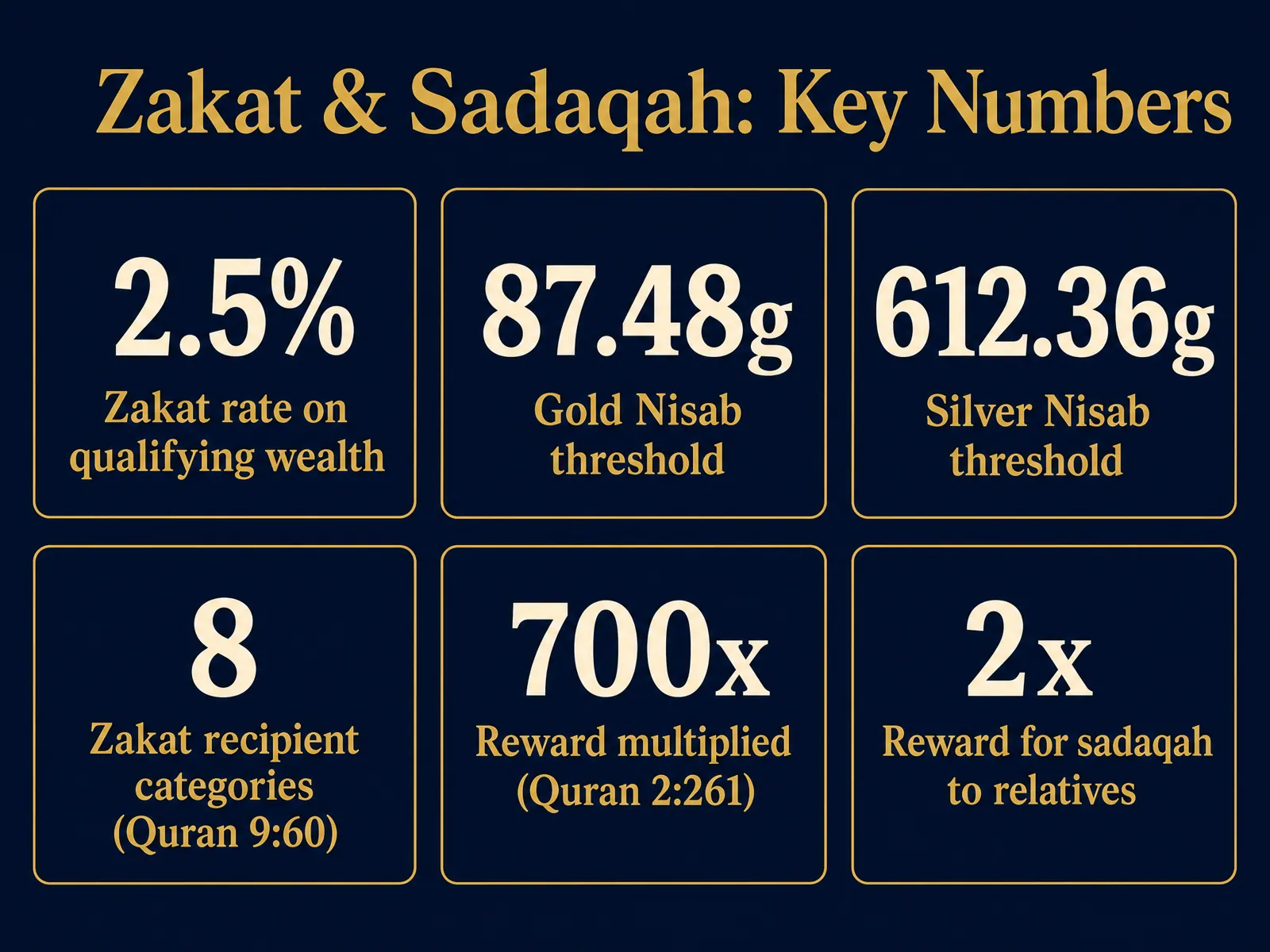
- Zakat is 2.5% of qualifying wealth that has stayed above the Nisab (87.48g of gold or 612.36g of silver) for one lunar year.
- Zakat may only go to the 8 categories named in Quran 9:60; sadaqah can go to anyone in need, including non-Muslims.
- Zakat cannot be given to your parents, children or spouse; sadaqah to relatives earns a double reward (Tirmidhi 658).
- Most scholars say zakat cannot fund building a mosque; sadaqah — and especially sadaqah jariyah — can.
- The Quran sometimes uses the word "sadaqah" to mean zakat (Quran 9:103), which is why the two are often confused.
- Sadaqah does not have to be money: Tirmidhi 1956 counts even a smile as charity.
What is the difference between zakat and sadaqah?
The difference between zakat and sadaqah comes down to obligation. Zakat is a fixed religious duty on Muslims whose wealth reaches a threshold, with a set rate, a set timing and a set list of recipients. Sadaqah is any charity given freely, out of goodwill, with no fixed rate, date or recipient list.
Put simply, all zakat is charity, but not all charity is zakat. You can give sadaqah every day of the year and still owe zakat, and paying zakat does not replace the voluntary giving the Quran and Sunnah encourage.
What is zakat?
Zakat is the third pillar of Islam: a compulsory annual payment of 2.5% on wealth that has remained above the Nisab for a full lunar year (the hawl). It purifies the giver's wealth and redistributes it from those who have more to those who have less.
The Prophet ﷺ described it when sending Mu'adh to Yemen: zakat "is to be taken from the wealthy among them and given to the poor" (Sahih al-Bukhari 1395). The Nisab is fixed by weight — 87.48g of gold or 612.36g of silver — so its pound value moves with metal prices. HNCO's Zakat calculator uses the current value for you.
For a step-by-step walkthrough, see how to fulfil your Zakat obligation in the UK, or start at our Zakat hub.
What is sadaqah?
Sadaqah is voluntary charity given for the sake of Allah, in any amount, at any time, to anyone in need. The word comes from the Arabic root ṣ-d-q, meaning truthfulness — giving is a sign of the sincerity of a person's faith.
The Quran promises that charity grows like a single grain that sprouts seven ears of a hundred grains each (Quran 2:261), and adds that giving privately "is better for you, and will absolve you of your sins" (Quran 2:271). Sadaqah also includes non-financial acts: "Your smiling in the face of your brother is charity" (Jami' at-Tirmidhi 1956).
A special form is sadaqah jariyah — ongoing charity such as a water well or masjid whose benefit continues after the giver dies (Sahih Muslim 1631). Read more in What is sadaqah? and the benefits of sadaqah.
How does zakat compare to sadaqah, point by point?
Zakat and sadaqah differ on eight practical points: status, amount, threshold, timing, recipients, family, non-Muslims and buildings. The table below sets them side by side.
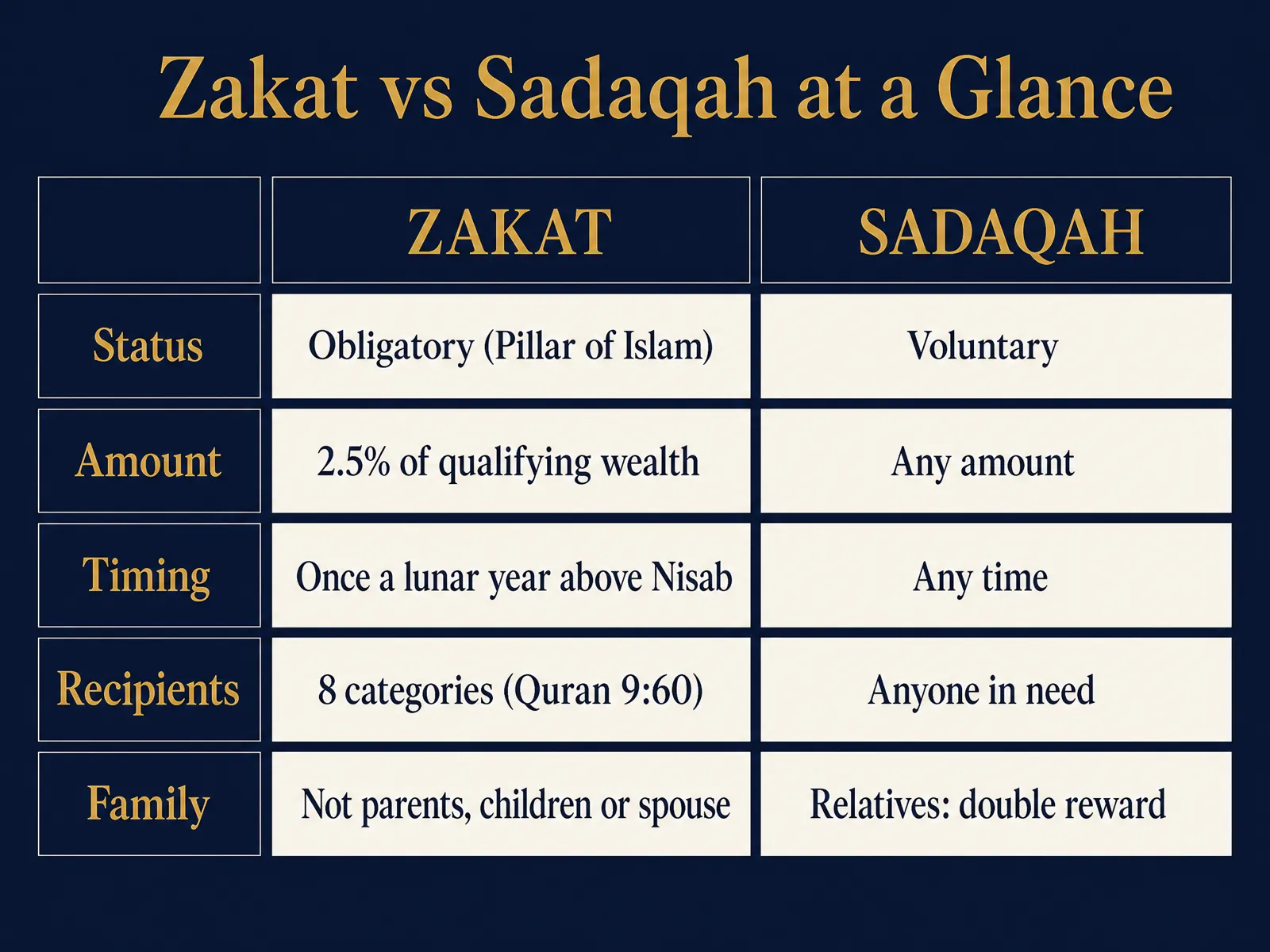
| Point | Zakat | Sadaqah |
|---|---|---|
| Status | Obligatory — third pillar of Islam | Voluntary and highly recommended |
| Amount | 2.5% of qualifying wealth | Any amount, including non-monetary acts |
| Threshold | Only due above the Nisab (87.48g gold / 612.36g silver) | No threshold — anyone can give |
| Timing | Once a lunar year (hawl) on wealth held above Nisab | Any time, as often as you like |
| Recipients | The 8 categories in Quran 9:60 | Anyone in need, plus good causes |
| Family | Not to parents, children or spouse | Encouraged — double reward to relatives |
| Non-Muslims | Not permitted (majority view) | Permitted, especially relatives and neighbours |
| Mosques and buildings | Not permitted (majority view) | Permitted — a classic sadaqah jariyah |
Who can receive zakat, and who can receive sadaqah?
Zakat can only go to the eight groups named in Quran 9:60: "the poor and the needy, … those employed to administer it, … those whose hearts are attracted ˹to the faith˺, … ˹freeing˺ slaves, … those in debt, … Allah's cause, and … ˹needy˺ travellers." If a recipient falls outside these groups, the payment does not count as zakat.
Sadaqah has no such list. It can feed a neighbour, support a relative, fund a hospital, dig a well or plant a tree. That flexibility is why sadaqah can fund community projects that zakat cannot.
Can zakat or sadaqah go to family, non-Muslims or a mosque?
Zakat cannot go to your own parents, children or spouse, cannot go to non-Muslims, and — in the majority view — cannot build a mosque; sadaqah can do all three.
- Family: Shaykh Ibn Baz rules that a Muslim "cannot give his zakah to his parents or to his children; rather he has to spend on them from his wealth" (IslamQA 20173), because supporting them is already a duty. Sadaqah to relatives, by contrast, "is two: charity and nurturing the ties of kinship" (Tirmidhi 658).
- Non-Muslims: voluntary charity "to poor non-Muslims, especially if they are relatives" is permitted, while zakat is for poor Muslims (IslamQA 3854).
- Mosques: "zakah is not to be spent on building mosques … rather it is to be spent on the eight categories" (IslamQA 21805). Building a masjid is therefore usually funded through sadaqah — see HNCO's build a masjid in Pakistan project.
Schools of thought differ on some details, so check with a scholar you trust if your situation is unusual.
Why does the Quran sometimes call zakat "sadaqah"?
The Quran uses "sadaqah" as a broad word for charity, so in some verses it refers to obligatory zakat. Quran 9:60 opens "innama as-sadaqat" — literally "the sadaqat are only for…" — yet it defines the recipients of zakat. Quran 9:103, "Take from their wealth … charity to purify and bless them", is also understood by Ibn Kathir as referring to zakat.
The same overlap appears in Zakat al-Fitr, also called Sadaqat al-Fitr. It is obligatory — the Prophet ﷺ "enjoined the payment of one Sa' … on every Muslim" before the Eid prayer (Sahih al-Bukhari 1503) — even though its name contains "sadaqah". See our Zakat al-Fitr guide. Related payments such as fidya and kaffarah are covered on our fidya, kaffarah and fitrana page.
When should you give zakat, and when sadaqah?
Give zakat when your qualifying wealth has stayed above the Nisab for a lunar year; give sadaqah whenever you want to, as often as you can. Many UK Muslims pay zakat once a year — often in Ramadan — and spread sadaqah across the year.
A practical pattern many donors use:
- Once a year: work out your zakat with the Zakat calculator and pay it to an eligible recipient.
- Every month: set up monthly sadaqah — the Prophet ﷺ said the most beloved deeds are those done consistently, even if small (Sahih al-Bukhari 6465). Our sadaqah calculator can help you choose an amount.
- For a lasting legacy: give sadaqah jariyah online, for yourself or on behalf of someone else.
Before giving either, it is worth knowing how to verify an Islamic charity in the UK.
Give sadaqah jariyah that lasts
A £150 hand-pump water well serves around 25 people for about 10 years; a £1,800 solar well serves around 100 people for about 20 years. Every pump is built in Pakistan and reported back to you.
Give a water well as sadaqah jariyah
Paying Zakat? Read how HNCO handles Zakat for water pumps.
Frequently asked questions about zakat vs sadaqah
Is zakat the same as sadaqah?
No. Zakat is an obligatory 2.5% payment on wealth above the Nisab, given to eight set categories. Sadaqah is voluntary charity of any amount, given at any time, to anyone in need. The Quran sometimes calls zakat "sadaqah", which is where the confusion comes from.
Can sadaqah count as zakat?
No. Zakat requires the intention of paying zakat at the time of giving and must reach one of the eight eligible categories. Money given as general sadaqah cannot be counted as zakat afterwards.
Can I give zakat to my family?
You cannot give zakat to your parents, grandparents, children, grandchildren or spouse, because you are already responsible for supporting them. Many scholars allow zakat to other eligible relatives such as siblings. Sadaqah to any relative is encouraged and carries a double reward.
Can sadaqah be given to non-Muslims?
Yes. Voluntary sadaqah can be given to non-Muslims in need, especially relatives and neighbours. The majority view is that zakat is for eligible Muslims only.
Can zakat be used to build a mosque?
The majority of scholars say no, because a mosque is not one of the eight zakat categories in Quran 9:60. Building a masjid is usually funded through sadaqah or sadaqah jariyah.
Is sadaqah jariyah zakat or sadaqah?
Sadaqah jariyah is a form of sadaqah — voluntary charity whose benefit continues over time, such as a water well, a masjid or beneficial knowledge.
Is lillah the same as sadaqah?
Lillah means "for the sake of Allah" and usually refers to donations given to an institution, such as a mosque or madrasah, rather than to individuals. It is a type of voluntary charity, so it follows the rules of sadaqah rather than zakat.
Do I still need to pay zakat if I give sadaqah regularly?
Yes. If your wealth is above the Nisab for a lunar year, zakat is due regardless of how much sadaqah you give. Sadaqah is extra reward on top of the obligation, not a replacement for it.
About HNCO — The Hajjah Naziha Charitable Organisation is a UK non-profit organisation based in Nelson, Lancashire, funding water wells, masjids and community relief in Pakistan and Kenya. Explore our water projects or donate.