
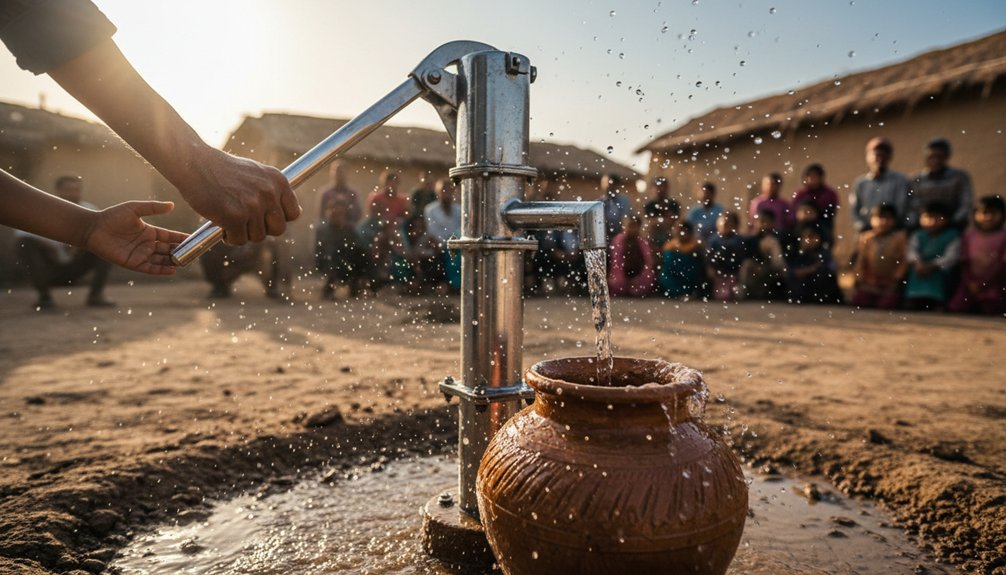
A water pump sadaqah jariyah is an ongoing Islamic charity — a solar or hand pump installed in a water-scarce community — that earns continuous spiritual rewards every time someone drinks, cooks, or washes with its water, for 20 years or more from a single donation.
Key Takeaways
- Sadaqah jariyah means "flowing charity" — it rewards the donor after death (Sahih Muslim, 1631).
- The Prophet ﷺ identified water as the best charity: "The best of charity is to give water" (Ahmad, Abu Dawud, Ibn Majah).
- 2.1 billion people lack safely managed drinking water globally — WHO/UNICEF, 2025.
- HNCO's £1,800 solar pump serves ~100 people in Pakistan for up to 20 years.
- A £150 hand pump serves four or more families for ~10 years.
- Women and girls worldwide spend an estimated 250 million hours every day collecting water — United Nations.
- You can contribute from £25 toward a live community solar pump appeal.
What is sadaqah jariyah — and why does it never stop rewarding?
Sadaqah jariyah (صدقة جارية) translates directly as "flowing charity." The Arabic root jara means to flow or run — the same word used for a running river. In Islamic theology it refers to a charitable act whose benefit continues reaching people long after the original deed, with rewards credited to the donor even after their death.
The foundation is a hadith narrated by Abu Hurairah and recorded in Sahih Muslim (1631): "When a man dies, all his deeds come to an end except three: ongoing charity (sadaqah jariyah), beneficial knowledge, and a righteous child who prays for him." This hadith is considered sahih (rigorously authenticated) by unanimous consensus of hadith scholars.
What makes sadaqah jariyah distinct from a regular donation is the unbroken chain of benefit. A one-off food parcel nourishes a family once. A water pump serves a community every day for two decades — each use generating a fresh act of charity traceable back to the original donor, long after that donor may have passed away. The sadaqah jariyah principle is that the reward is proportional to the scale and duration of ongoing benefit — which is precisely why water infrastructure ranks so highly.
Why does the Prophet ﷺ single out water as the best charity for sadaqah jariyah?
Multiple hadith traditions place water at the summit of the sadaqah hierarchy. The Prophet ﷺ is reported to have said: "The best charity is to give water" (narrated by Ahmad, Abu Dawud, and Ibn Majah). The reasoning was literal in seventh-century Arabia — and remains literal today. In communities without clean water, every day begins with the existential problem of finding safe water to drink.
A particularly instructive narration involves Sa'd ibn Ubadah, who asked the Prophet ﷺ what charity he should give on behalf of his deceased mother. The Prophet ﷺ replied simply: "Water." Sa'd then dug a well and dedicated it to her — establishing the tradition of water charity as memorial giving, a practice HNCO continues through its water donation in memory of a parent programme.
Modern humanitarian data aligns perfectly with this prophetic prioritisation. According to the WHO and UNICEF (2025), 2.1 billion people still lack safely managed drinking water — roughly 1 in 4 people on earth. Waterborne diseases from contaminated water claim approximately 1.2 million lives each year. A functioning pump addresses the root cause of this suffering at community level: precisely the kind of comprehensive, durable benefit Islam identifies as the highest form of giving.
How does a water pump sadaqah jariyah generate decades of ongoing reward?
The reward mechanism is direct: every beneficial use of the water counts as a separate sadaqah for the original donor. Consider a solar-powered pump serving 100 people. If each person draws water three times a day — for drinking, cooking, and washing — that is 300 individual acts of charity per day. Over 20 years, a single £1,800 pump generates more than 2.1 million individual charitable transactions traceable to one donor's decision.
The compounding effects extend further. Clean water means fewer waterborne illnesses, so children attend school rather than recover from sickness; parents work rather than care for ill family members; women spend hours on livelihoods rather than walking kilometres to unsafe sources. According to the United Nations, women and girls globally spend an estimated 250 million hours every day collecting water — time that a local pump returns to them permanently, every day for two decades.
HNCO documents every installation with GPS coordinates, photographs, and video completion reports so donors can witness the ongoing impact of their donation. Past installations are logged at water pump completion reports.
What is the difference between a hand pump and a solar pump for water pump sadaqah jariyah?
Both a hand pump and a solar-powered pump qualify as water pump sadaqah jariyah. They differ substantially in cost, capacity, and how long they serve a community. HNCO offers both from the UK for installation in Pakistan. The table below summarises the key differences.
| Feature | Hand Pump (Manual) | Solar Pump ★ Most Popular |
|---|---|---|
| Cost with HNCO | £150 | £1,800 |
| People served | 4–6 families | ~100 people (20–25 families) |
| Operational lifespan | ~10 years | ~20 years |
| Power source | Manual effort | Solar panel — no running cost |
| Water storage | None | Elevated storage tank included |
| Best for | Individual / small group gifts | Whole communities, mosque groups |
| Named dedication plaque | Yes | Yes + GPS coordinates + video |
| Group contribution | Not typical | Yes — from £25 per person |
If you want to fund a complete water pump sadaqah jariyah independently, the solar pump at £1,800 delivers the greatest benefit per pound over its lifetime. If you prefer to contribute as part of a community, HNCO's group water donation scheme pools contributions from families, friends, or mosque congregations toward one shared installation. The hand pump at £150 is a complete sadaqah jariyah in its own right — accessible for individuals or as an additional gift. A detailed comparison is at hand pump vs solar water pump.
How much does a water pump sadaqah jariyah cost in 2026?
With HNCO, a water pump sadaqah jariyah is available at three levels:
- £25+ — a contribution toward the live community solar pump appeal (Solar Pump #16 is currently 62% funded)
- £150 — a complete hand pump installed in Pakistan, serving 4–6 families for ~10 years, with a named plaque
- £1,800 — a complete solar-powered pump serving ~100 people for ~20 years, with a named plaque, GPS coordinates, and a video completion report
HNCO also accepts monthly water pump donations for donors who want to spread the cost of a full solar pump. Zakat is accepted for water pump projects — see the water pump zakat guide for scholarly conditions and eligibility. The benefits of sadaqah more broadly are explored on HNCO's sadaqah pages for donors who want theological context alongside their giving.
For a breakdown of how each donation is used in the field, see how water pump donations work and how your donations are spent.
Who benefits from a water pump sadaqah jariyah donation?
HNCO installs pumps primarily in rural Pakistan, where access to clean water remains a critical public health issue. The water pump Pakistan programme targets villages without piped infrastructure — communities where families currently walk long distances to collect water from unprotected, often contaminated, sources.
Immediate beneficiaries are the families who use the pump daily. The wider effects compound over time. According to World Vision, communities with clean water access see school attendance rise, income-generating activity increase, and rates of waterborne illness fall substantially. In a typical HNCO solar pump installation, an elevated storage tank means water is available throughout the day without physical effort — critically important for elderly residents and mothers with young children.
Each HNCO installation includes community maintenance training so local residents can carry out basic servicing and extend the pump's operational life. You can watch beneficiaries using completed pumps at progress videos from completed installations, and compare how HNCO documents its work using video vs GPS verification.
Can you dedicate a water pump sadaqah jariyah in someone's memory?
Yes — and this is exactly what the Prophet ﷺ recommended when asked how to give charity for a deceased person. The narration of Sa'd ibn Ubadah is the primary scholarly basis for memorial water charity: the Prophet's instruction was not symbolic but practical — dig a well, provide water, generate ongoing benefit and ongoing reward for the person who has died.
HNCO's donate a water pump in someone's name service provides a named plaque on the installation and a completion report with GPS coordinates and photographs. The family receives tangible evidence of exactly where and how their loved one's memorial is serving the community. A dedicated page for water donation in memory of a parent covers the process in full.
The theological significance here is precise: the ongoing nature of the water's benefit means the deceased person continues to receive reward from Allah for as long as the pump operates. The memorial is not symbolic — it is functionally continuous, which is the definition of sadaqah jariyah. This also connects to the concept of forever donations — giving that outlasts the donor in every sense.
How do you verify a water pump charity is trustworthy?
Transparency is the critical variable when directing a water pump sadaqah jariyah donation. The markers of a trustworthy water pump charity are:
- Charity Commission registration — verifiable on the UK register, confirming independent oversight
- GPS coordinates for each installation — not just photographs, which can be reused
- Video completion reports showing the pump in use with local beneficiaries
- Community maintenance training — a pump with no maintenance plan has a shortened operational life
- Named donor dedication — written confirmation the installation is attributed to your donation
HNCO provides all five. Its pump completion reports include GPS coordinates, photographs, and video of every installation. The water well donation legitimacy page addresses common donor questions about verifying HNCO's work. For a wider view of accountability, how your donations are spent provides a full breakdown of project costs and field expenditure.
Frequently asked questions about water pump sadaqah jariyah
What is water pump sadaqah jariyah?
Water pump sadaqah jariyah is an ongoing Islamic charity in which you fund a water pump that serves a community for 20–30 years. Every time someone uses that water, the donor earns continuous spiritual rewards — even after death. The concept is grounded in Sahih Muslim (1631): "When a man dies, all his deeds come to an end except three: ongoing charity, beneficial knowledge, and a righteous child who prays for him."
How much does a water pump sadaqah jariyah cost in the UK?
With HNCO, a hand pump costs £150 and a solar-powered pump costs £1,800. You can contribute from £25 toward a community solar pump appeal — Solar Pump #16 is currently live. Both options are installed in Pakistan with a named dedication and full documentation.
How many people does a single water pump sadaqah jariyah serve?
HNCO's solar pump typically serves around 100 people and operates for up to 20 years. A hand pump serves four to six families for approximately 10 years. The solar pump includes an elevated storage tank, so water is available throughout the day without physical effort from users.
Is a water pump the same as a water well for sadaqah jariyah?
In Islamic charity contexts the two terms are commonly used interchangeably. What HNCO calls a "water well" is a solar-powered pump installed in a borehole — the full system from drilling to pump to storage tank. The key factor for sadaqah jariyah is that the installation delivers clean, reliable water long-term. See HNCO's guide to water pump vs water well for the technical distinction.
Can I dedicate a water pump sadaqah jariyah in memory of a deceased parent?
Yes — this is specifically what the Prophet ﷺ recommended. When a Companion asked how to give charity on behalf of his deceased mother, the Prophet replied "Water," and the Companion dug a well in her name. HNCO's water donation in memory of a parent programme provides a named plaque, GPS coordinates, and a video completion report.
Can zakat be used to fund a water pump sadaqah jariyah?
Yes, provided the recipients are among the eight categories of zakat-eligible people and the project directly benefits them. HNCO accepts zakat for water pump projects in Pakistan. See the full water pump zakat guide for scholarly guidance and conditions.
Does a broken water pump still count as sadaqah jariyah?
Islamic scholars generally hold that the original intention and donation earn reward, but the ongoing jariyah reward requires the pump to be functioning and actively benefiting people. This is precisely why HNCO includes community maintenance training with every installation — a functioning pump is the mechanism through which the reward continues.
Can multiple people pool together for one water pump sadaqah jariyah?
Yes. HNCO's group water donation scheme allows families, friends, or mosque congregations to pool contributions from £25 per person toward a single solar pump installation. All contributors are named as donors for that pump, sharing in its rewards. This makes the full £1,800 solar pump accessible to any community that wants to give together.